
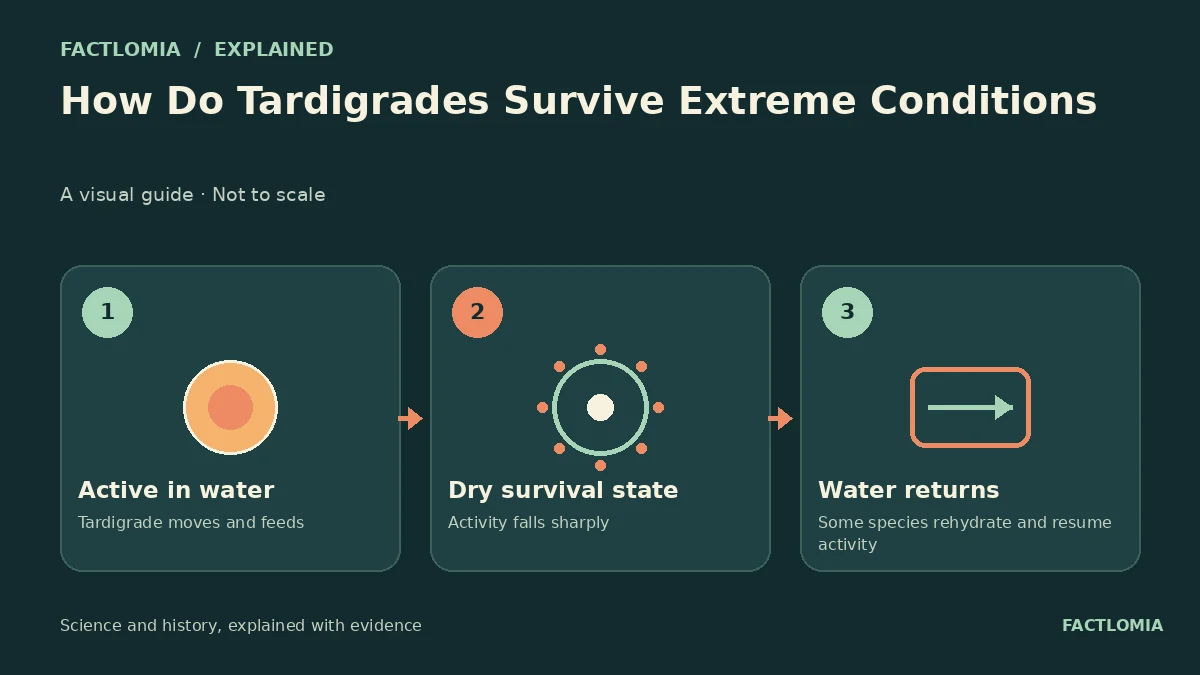
Some tardigrades survive harsh conditions by entering a low-activity state, often after losing most of their body water. This process, called anhydrobiosis, can help certain species tolerate drying and some other stresses. It does not make them indestructible: tolerance differs among species, and active tardigrades can be much more vulnerable.
A microscopic animal waits for water
Tardigrades are tiny eight-legged invertebrates, often nicknamed water bears. Many live in films of water around moss, soil, or aquatic habitats. When their environment dries, some species contract into a compact form and enter anhydrobiosis, a state in which metabolism becomes extremely low. When water returns, they can rehydrate and become active again. [1]
Survival has biological limits
Drying can damage cells, so tardigrades rely on protective mechanisms involving cell structures and molecules. Research is still clarifying exactly how these systems work across species. A recent multi-species study found that tolerance to heat varied and that anhydrobiosis increased tolerance compared with active, hydrated animals. The limits depend on species, exposure time, temperature, and whether the animal is hydrated. [2]
The ‘indestructible’ label goes too far
Some tardigrades have survived particular laboratory exposures to extreme cold, pressure, radiation, or space-like conditions in a dormant state. Those findings do not mean every tardigrade can survive any extreme, or that it can live indefinitely without water. Dormancy is a survival strategy under specific conditions, not a superpower without limits. [3]
Frequently asked questions
Can tardigrades survive in space?
Experiments have shown survival by some tardigrades under specific space-exposure conditions, generally while in a dormant, dried state. This is not true of every species or every exposure.
Are tardigrades immortal?
No. They are animals with finite lifespans and species-specific tolerances.
What is anhydrobiosis?
It is a reversible state associated with extreme drying, in which an organism’s activity and metabolism become greatly reduced.
Sources and evidence
- NASA — What Is a Tardigrade? ↗
NASA educational overview of tardigrades and anhydrobiosis.
- Molecular Biology and Evolution — Thermal Tolerance in Tardigrades ↗
Peer-reviewed comparison of thermal tolerance in six species, active and dry.
- Journal of Experimental Biology — How Long Can Tardigrades Survive in Anhydrobiosis? ↗
Reviews the limited evidence on long-term survival in the dried state.
Sources consulted: 4 November 2026. Written with AI assistance and checked against the linked references; not independently reviewed by a subject specialist. Sources do not endorse this article. See our editorial policy.
Revision: New explainer; corrects claims that tardigrades are invulnerable or immortal.