
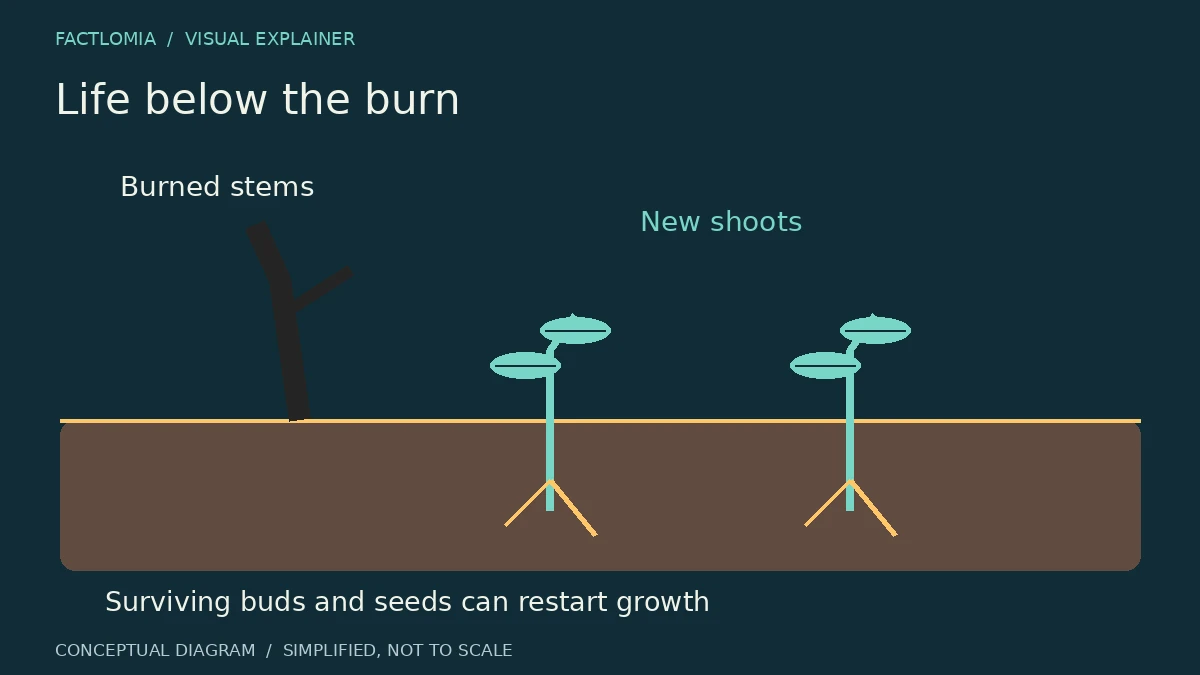
Plants regrow after a wildfire through several routes: protected buds and roots can send up new shoots, seeds stored in soil or cones can germinate, and seeds can arrive from unburned areas. Some plants have traits adapted to fire, but no single recovery pattern applies to every ecosystem. Fire intensity, timing, and repeat burns affect which plants return.
Protected buds can send up new shoots
Some shrubs and trees store buds near or below the soil surface, where they may survive heat that kills branches above ground. After the fire, those buds can sprout from a root crown or woody base. The USDA Forest Service documents species whose buried buds and deep roots support post-fire resprouting. [1]
Seeds can survive or be released after fire
Seeds may persist in soil, be protected within cones, or germinate when heat or smoke changes their surroundings. Other plants rely on seeds from surviving patches or nearby unburned ground. Which pathway matters most differs by species and habitat. A burned landscape can therefore recover as a mosaic rather than returning uniformly. [1][2]
A burn can help some plants and harm others
Some species are adapted to occasional fire, while others are killed by it. Very intense or repeated fires can destroy seed sources, damage soil, or leave too little time for plants to mature and reproduce. Recovery also depends on rainfall, temperature, invasive species, and the size of the burned area. “Fire adapted” does not mean a plant benefits from every fire regime. [2]
Why a blackened landscape may still be alive
Roots, buried seeds, surviving trees, and unburned refuges can remain even when the surface looks bare. New green shoots may appear first, while forest structure takes much longer to recover. In some places natural regeneration is limited and restoration may be needed. See how plants respond to their environment for another example of plant behavior.
Frequently asked questions
Do all plants come back after a wildfire?
No. Some resprout or recolonize from seed; others may be killed, especially after intense or repeated burns.
How soon does regrowth begin?
Some shoots and seedlings can appear in the first growing season, but the timing depends on species, weather, and the fire.
Should every burned area be replanted?
Not necessarily. Some places regenerate naturally; others need restoration if seed sources or soil conditions have been severely affected.
Sources and evidence
- USDA Forest Service — Fire Effects Information System: Eastwood’s Manzanita ↗
Example of post-fire sprouting from protected buds and seeds.
- USDA Forest Service — Fire Effects Information System ↗
Research database on fire adaptations and post-fire responses across plant species.
Sources consulted: 2026-10-27. Written with AI assistance and checked against the linked references; not independently reviewed by a subject specialist. Sources do not endorse this article. See our editorial policy.
Revision: First published 27 October 2026. Original explanatory diagram; claims checked against linked sources.