
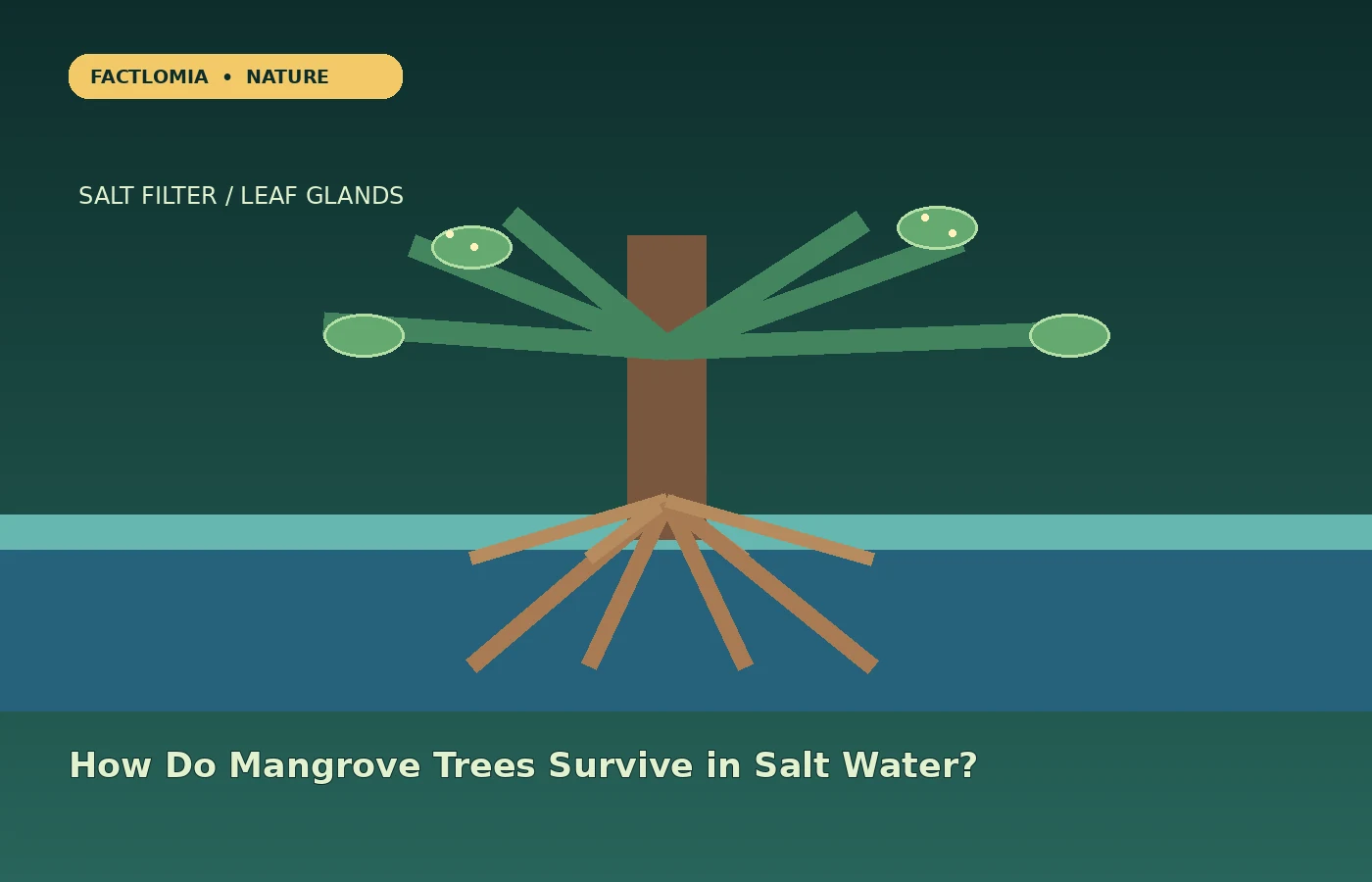
Mangroves survive in salty coastal habitats through a mix of adaptations. Some species exclude much of the salt at their roots; others secrete salt through glands on their leaves, store excess salt in older leaves, or use several strategies together. They still need fresh water for normal plant functions and can be harmed when salinity or flooding becomes too extreme.
Salt makes taking up water harder
Salty soil creates an osmotic challenge: water is harder for roots to draw in because the surrounding solution is more concentrated. Mangroves live in intertidal environments where salinity changes with tides, rainfall and river flow, so their adaptations must work across shifting conditions.
Different mangrove species manage salt in different ways. Some act as “salt excluders,” filtering much of the salt before water enters the plant. Other species, including black mangroves in the genus Avicennia, can move excess salt out through specialized glands in their leaves. NOAA describes both root filtration and leaf secretion. [1]
Leaves can export salt
When salt-secreting glands release salt, crystals may collect on the leaf surface and later wash or blow away. Some mangroves also tolerate or store salt in older leaves. As those leaves age and drop, some of the stored salt leaves with them. The balance varies by species, and the adaptations can overlap rather than fitting each tree into a single category. [2]
These strategies do not mean mangroves need seawater. They can grow with fresh water too, but their salt tolerance gives them an advantage along warm coasts where many competitors cannot cope with regular saltwater flooding.
Salt tolerance is only part of the survival toolkit
Mangroves also contend with waterlogged mud that contains little oxygen. Many species grow aerial roots that exchange gases with the air, while spreading and prop roots help anchor trees in soft, shifting shorelines. Their seedling strategy helps as well: propagules can begin developing while attached to the parent plant, then detach and float until they reach suitable ground. [3]
Can mangroves survive any amount of salt? No. Extreme salinity, long flooding, drought and coastal development can stress or kill them. Do all mangroves have salt glands? No. Some mainly exclude salt at their roots, while others secrete it or use multiple mechanisms. The details differ among species and environments. Learn how plants respond to challenging conditions in this guide to plant recovery after wildfires.
What the evidence does—and does not—show
| What is supported | Important limit |
|---|---|
| Mangroves use salt-management adaptations that vary among species. | Not every mangrove has salt glands, and salt tolerance does not mean unlimited tolerance. |
This summary draws on the references listed below. Follow the source links for the observations and their context.
Sources and evidence
- Smithsonian Ocean — Mangroves ↗
Explains root salt exclusion, leaf secretion, salt storage and mangrove habitat.
- NOAA National Ocean Service — Adaptations to Life in the Estuary ↗
Describes salt filtration, leaf glands, aerial roots and intertidal adaptations.
- NOAA — Oil Spills in Mangroves: Planning and Response Considerations ↗
Technical overview of salinity tolerance mechanisms, including root ultrafiltration and salt secretion.
Sources consulted: 29 October 2026. Written with AI assistance and checked against the linked references; not independently reviewed by a subject specialist. Sources do not endorse this article. See our editorial policy.
Revision: New article treats salt exclusion, secretion and storage as species-dependent strategies, not a single universal mechanism. Updated 30 October 2026: added an evidence summary and clarified the limits of the explanation; repaired text formatting.