
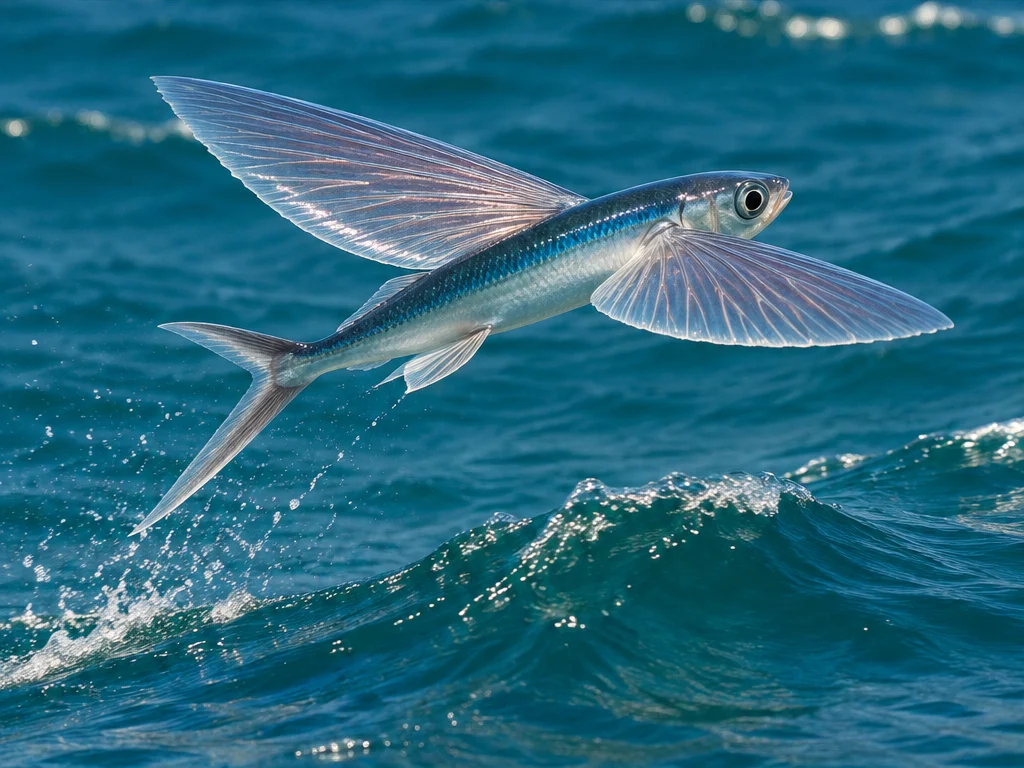
A flying fish accelerates underwater, breaks through the surface and spreads its long pectoral fins. Those fins support a glide while the fish’s initial speed carries it forward. Some flying fish can give themselves another push by dipping the lower part of the tail back into the water.
The launch starts in the water
The fish holds its big fins close to its body as it swims. Rapid tail beats accelerate it toward the surface. The tail’s lower lobe extends farther down than the upper lobe, so it can keep pushing against the water briefly even after most of the fish has emerged. This helps it gain the speed needed to glide. [1]
What the fins do in the air
As soon as the fish clears the surface, the pectoral fins spread to form broad gliding surfaces. In some species, enlarged pelvic fins provide a second pair farther back. Air flowing around the fins generates lift and lets the fish travel farther than a simple leap would carry it. The glide gradually loses speed unless the tail finds water again. [1]
Why leave the ocean at all?
Gliding can give a fish a brief way to escape a predator pursuing it underwater. The tradeoff is that a leap exposes it to seabirds. The fish eventually returns to the water, or skims the surface with its tail and launches into another glide. [1]
Read also how airplane wings generate lift.
Frequently asked questions
Do flying fish flap their fins to stay up?
Their enlarged fins mainly act as gliding surfaces. Tail strokes against water supply the push.
Do all flying fish have four enlarged fins?
Some have enlarged pelvic fins as well as enlarged pectoral fins. Others glide mainly on the pectoral pair.
Sources and evidence
- National Wildlife Federation — Flying Fish ↗
Launch mechanics, extended fins, gliding and predator avoidance.
Sources consulted: 28 November 2026. Written with AI assistance and checked against the linked references; not independently reviewed by a subject specialist. Sources do not endorse this article. See our editorial policy.
Revision: Initial publication.