
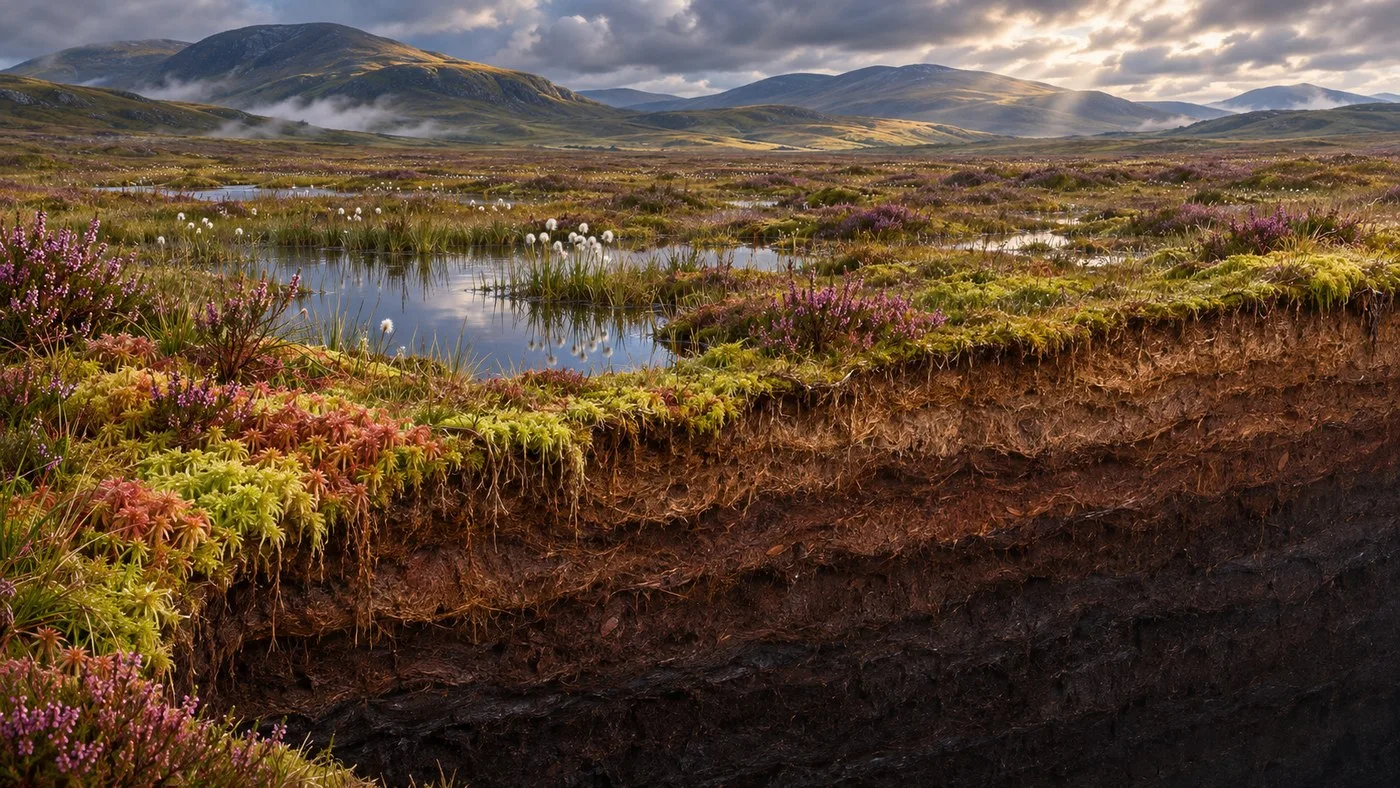
The Flow Country stores carbon because its cool, wet, poorly drained peatlands slow the decay of dead plants. Vegetation accumulates faster than it fully decomposes, forming peat that can hold carbon for thousands of years. This is a rare, water-dependent landscape—not empty ground waiting to become forest.
A wet landscape that preserves plant material
The Flow Country is a broad blanket-bog system in northern Scotland, with mosses, grasses, heather and pools. Persistent rainfall and poor drainage keep the soil waterlogged. Saturation limits microbial activity that would otherwise break down dead plant material and release carbon dioxide. Partly decomposed vegetation builds into peat. [1]
Why peat is a long-term carbon store
Plants take carbon dioxide from the air as they grow. In a well-drained ecosystem, decomposition returns much of that carbon to the atmosphere. In a bog, waterlogged soils slow decomposition, leaving more carbon in the ground. NASA reports that some local peat deposits exceed eight meters and began accumulating more than 9,000 years ago; depth and age vary by location. [1]
A globally important natural site
The Flow Country became a UNESCO World Heritage Site in 2024. Peatlands store carbon only while their wet conditions remain intact. Drainage, fire or disturbance can speed decomposition and damage wildlife adapted to the bog. Restoring water flow and limiting destructive land use can help protect this slow-forming ecosystem. [1]
FAQ: peatland carbon
Is peat ordinary soil? It is soil rich in partly decomposed plant matter that accumulates in wet conditions.
Would planting trees store more carbon there? Not necessarily; trees can alter the hydrology and harm open-bog species.
Why does drainage matter? Drier peat decomposes faster and can be more vulnerable to erosion and fire.
Sources and evidence
- NASA Earth Observatory — Scotland’s Flow Country ↗
Peat formation, landscape, UNESCO context and carbon storage.
- NatureScot — The Flow Country World Heritage Site ↗
Regional extent, site status and peatland significance.
Sources consulted: 14 November 2026. Written with AI assistance and checked against the linked references; not independently reviewed by a subject specialist. Sources do not endorse this article. See our editorial policy.
Revision: Initial publication. Claims and limitations checked against linked institutional and primary sources.