
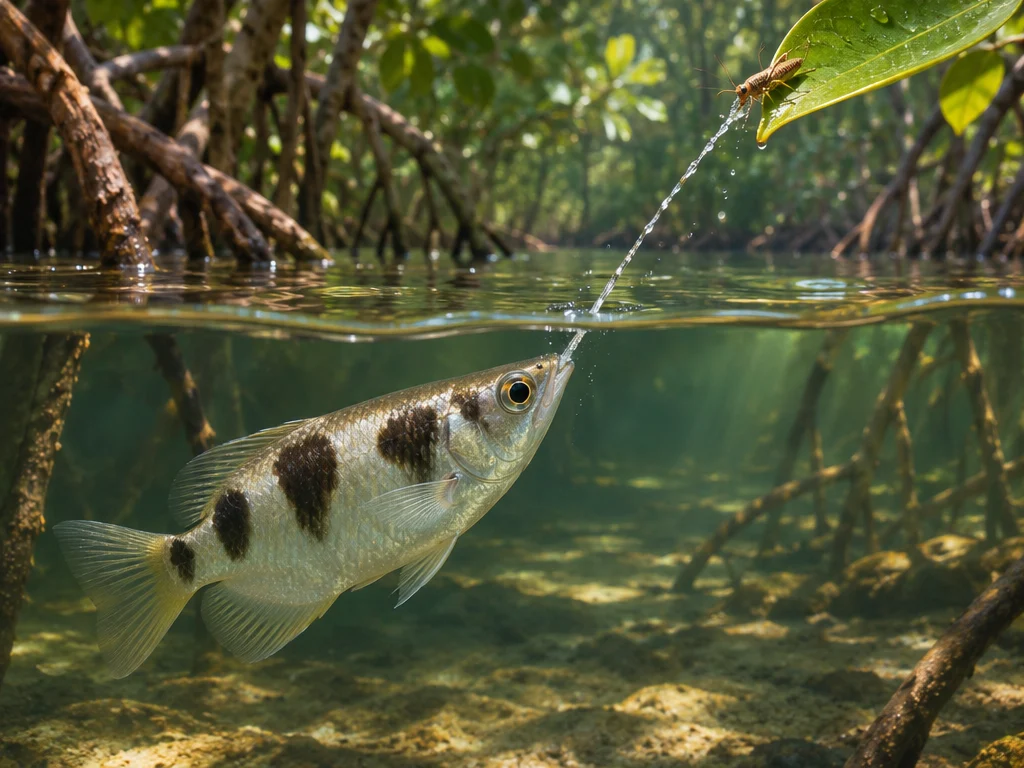
An archerfish aims from just beneath the surface and shoots a narrow stream of water from its mouth. The jet can knock an insect off a leaf and into the water. The fish has to account for the way light bends as it crosses from air into water.
A meal above the waterline
Banded archerfish patrol shallow habitats including mangroves and estuaries. From close to the surface, a fish can spot insects on low branches. It directs a burst of water upward. A hit dislodges the insect, which falls within reach of the fish. [1]
Why the target looks out of place
Light changes direction when it crosses the air-water boundary at an angle. An insect viewed from below therefore appears along a different line from the one the fish would trace through a single medium. Archerfish compensate well enough to strike prey from below. Practice helps young fish refine their shots. [1]
What happens when the jet is pushed sideways
In one study, researchers introduced an airflow that deflected water jets aimed at a target. The fish gradually corrected their shots. When researchers removed the airflow, the fish initially missed in the opposite direction, consistent with having adapted their aim to the earlier disturbance. [2]
Read also why a straw looks bent in water.
Frequently asked questions
Do archerfish only hunt by shooting?
They can also catch prey directly, including by jumping at insects within reach.
Does the water jet follow the same path as the light?
The jet is a moving stream of water. Its trajectory through air is shaped by its launch and gravity, while the fish sees the prey through refracted light.
Sources and evidence
- Los Angeles Zoo — Banded Archerfish ↗
Natural hunting behavior and compensation for refraction.
- eLife — Motor Adaptation in Archerfish Shooting ↗
Experiments testing whether archerfish correct for altered shot trajectories.
Sources consulted: 28 November 2026. Written with AI assistance and checked against the linked references; not independently reviewed by a subject specialist. Sources do not endorse this article. See our editorial policy.
Revision: Initial publication.