
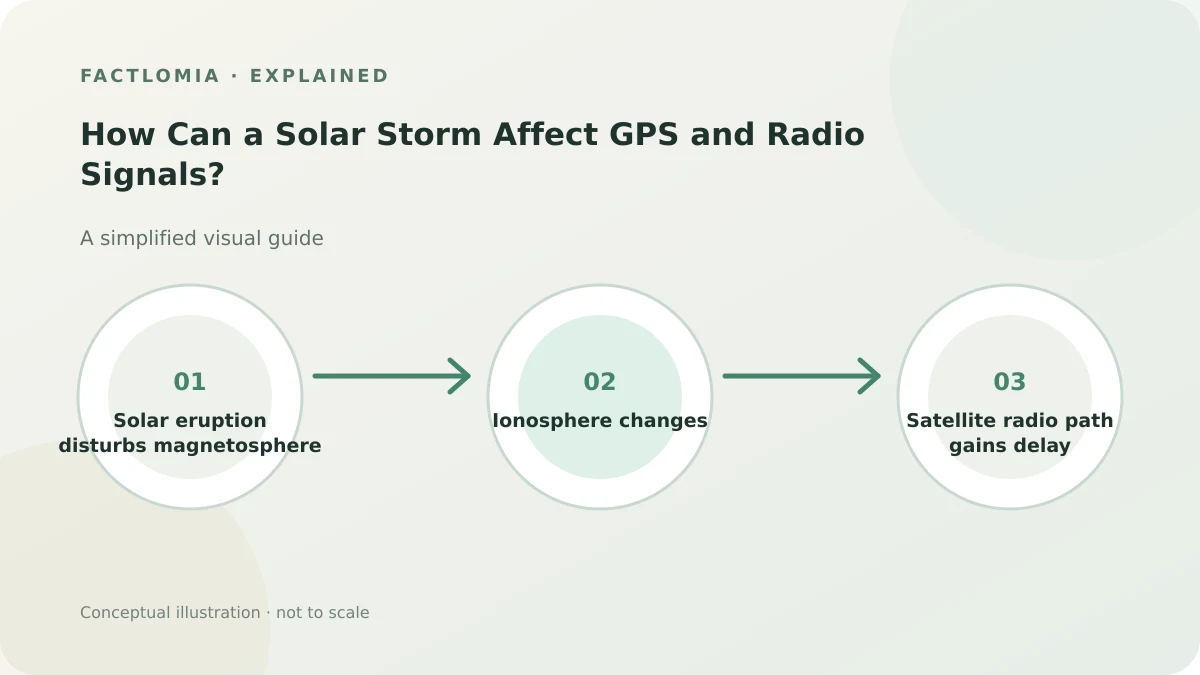
A solar storm can disturb Earth’s magnetosphere and ionosphere. Changes in the ionosphere can delay or distort radio signals traveling between navigation satellites and receivers, while severe disturbances can degrade some high-frequency radio communication. Effects vary by storm strength, location and signal path.
Solar activity can disturb Earth’s magnetic environment
Solar flares and coronal mass ejections can send radiation or magnetized material toward Earth. When solar-wind energy interacts with Earth’s magnetosphere, it can trigger a geomagnetic storm. The same space-weather events that enhance auroras can also change conditions in the upper atmosphere. [1]
GPS signals pass through the ionosphere
Navigation satellites send radio signals that travel through the ionosphere before reaching receivers on the ground. Charged particles in that region affect how the signals propagate. During disturbed conditions, the signal delay can change, increasing positioning error; in some cases, a receiver may lose signal lock. Systems that use multiple frequencies and correction data can reduce some errors, but performance still depends on the event and location. [2]
Radio effects depend on the type of disturbance
Solar radio bursts and ionospheric changes can affect different radio services in different ways. High-frequency radio on the sunlit side of Earth can experience degradation during some events. A visible aurora does not automatically mean everyday GPS will fail; space-weather severity, geographic location and the technology being used all matter.
For the light show itself, see what causes auroras.
Frequently asked questions
Does every northern-lights display disrupt GPS?
No. Aurora visibility and navigation impacts are related to space weather but do not map one-to-one; severity and location matter.
Can a solar storm make GPS inaccurate?
It can increase signal delay and positioning errors, and severe disturbances may interrupt reception.
Do solar storms affect all radio signals equally?
No. Effects depend on frequency, time of day, ionospheric conditions and the path between transmitter and receiver.
Sources and evidence
- NOAA Space Weather Prediction Center — What Is a Geomagnetic Storm? ↗
Geomagnetic storms and their effects on radio communication and aurora.
- NOAA Space Weather Prediction Center — Space Weather Impacts ↗
Operational effects of space weather on GPS, radio, satellites and other technologies.
Sources consulted: 1 November 2026. Written with AI assistance and checked against the linked references; not independently reviewed by a subject specialist. Sources do not endorse this article. See our editorial policy.
Revision: Initial publication. Claims and uncertainty checked against the cited references.