
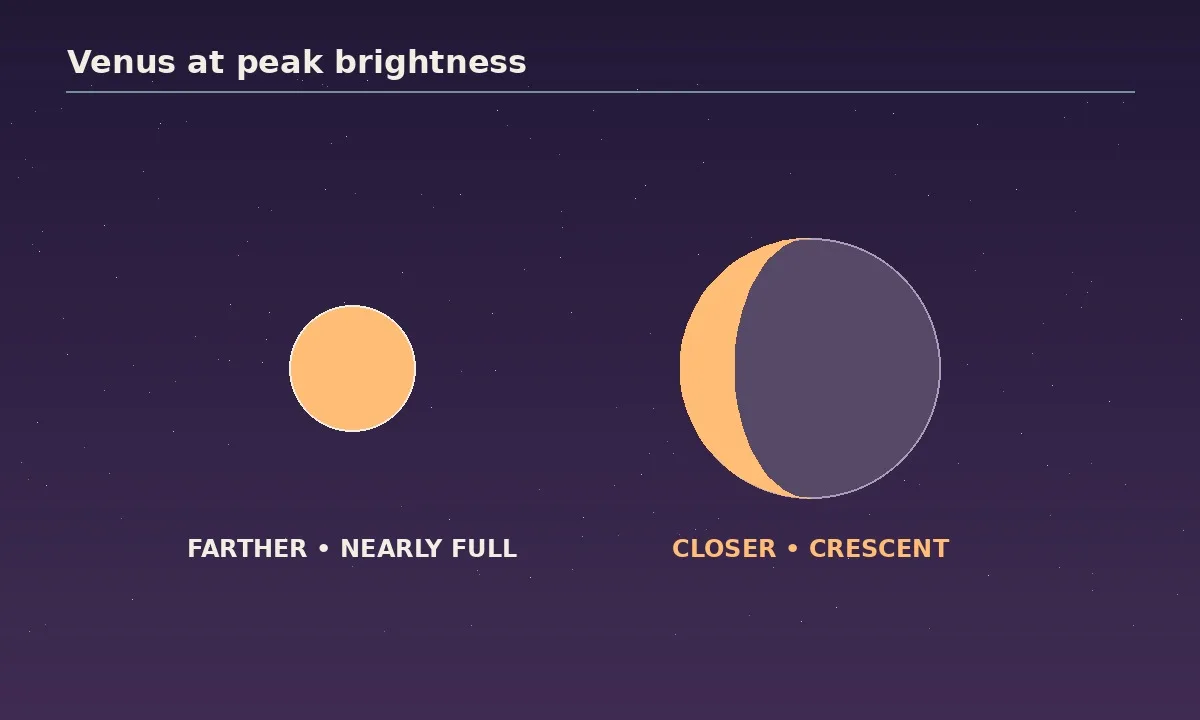
Venus can shine brightest as a crescent because it is then much closer to Earth than when it looks nearly full. A larger apparent disk can make its slim sunlit portion reflect more light toward us.
Two changes compete
Venus orbits inside Earth’s orbit, so its appearance changes as we see different amounts of its sunlit side. When Venus is on the far side of the Sun, most of its facing disk is lit, but that disk looks small from Earth. As the planet comes closer, the disk grows and the visible illuminated fraction shrinks. [2]
A bigger slice can still mean more light
Imagine a large pizza with one thick slice left and a much smaller pizza that is almost whole. The single slice can cover more of the table. Venus’s brightness likewise depends on its apparent size and phase, and on the way its clouds scatter light. An extremely thin crescent near the Sun loses much of that advantage. [2]
Look for Venus before sunrise
Late November 2026 provides a morning example. Look low in the eastern sky before sunrise. Your eyes can pick out the bright planet, while its crescent shape is a detail for magnified views before the Sun comes up. [1]
Frequently asked questions
Why can Venus be a morning star or an evening star?
Depending on where Venus is in its orbit, it appears west of the Sun in the morning or east of it in the evening.
Can I see the crescent with my eyes alone?
The unaided eye generally sees a bright point. Magnification makes the shape easier to see.
Sources and evidence
- timeanddate November 2026 sky guide ↗
Late-November peak brightness and morning visibility.
- timeanddate Venus phase explainer ↗
How illuminated fraction and apparent size affect the visible light.
Sources consulted: 12 November 2026. Written with AI assistance and checked against the linked references; not independently reviewed by a subject specialist. Sources do not endorse this article. See our editorial policy.
Revision: Initial publication.