
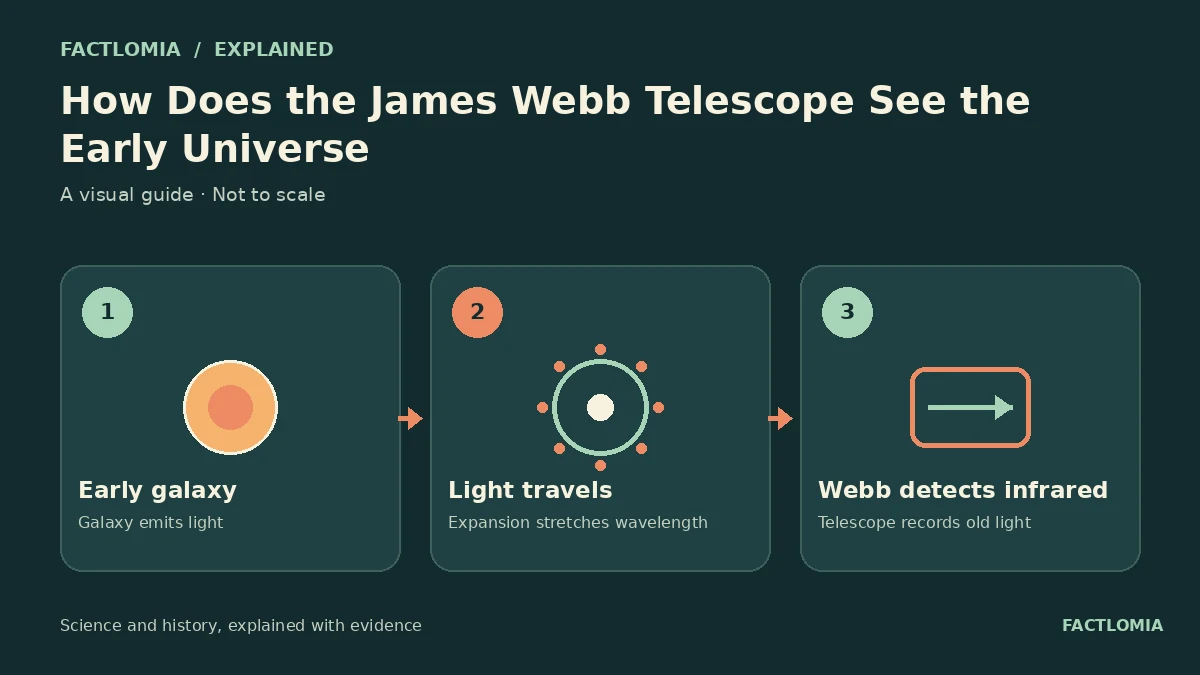
The James Webb Space Telescope sees the early universe by collecting faint infrared light from distant galaxies. Because that light has traveled for billions of years, Webb observes those galaxies as they were long ago. The expansion of the universe stretches the light toward longer, infrared wavelengths, which Webb’s instruments are designed to detect.
Looking far away means looking back in time
Light takes time to cross space. When a telescope detects light from a galaxy billions of light-years away, it receives light that began its journey billions of years ago. Webb therefore observes an earlier stage of that galaxy’s history; it does not travel back in time or photograph the Big Bang itself. [1]
Why ancient light becomes infrared
As the universe expands, the space traveled by light stretches its wavelength. Light that began as ultraviolet or visible radiation can arrive at Earth shifted into infrared. Webb was built to observe near- and mid-infrared wavelengths, helping astronomers study distant galaxies whose light has been redshifted. [1]
What Webb can—and cannot—show
Webb has found galaxies from very early cosmic history and helps scientists test ideas about how stars and galaxies formed. A telescope image is evidence to interpret, not a time-lapse movie: astronomers estimate distance and age from measurements such as a galaxy’s spectrum and redshift. Webb is helping answer questions about the first stars, but the exact timing and formation of the earliest stars remain under study. [2]
Frequently asked questions
Does Webb photograph the Big Bang?
No. Webb observes light from objects that formed after the Big Bang; it cannot see the Big Bang itself as a camera image.
Why does Webb use infrared light?
Expansion stretches light from distant galaxies toward infrared wavelengths, and infrared can reveal objects whose visible light is faint or shifted.
How old is the universe?
NASA describes the universe as about 13.8 billion years old; measurements and models are refined as evidence improves.
Sources and evidence
- NASA — Webb and the Early Universe ↗
Explains redshift, infrared observations, and Webb’s early-universe science.
- NASA — Webb’s Orbit ↗
Mission context for the telescope’s location and design.
- NASA — Webb’s First Deep Field ↗
Describes how Webb’s observations reveal distant galaxies.
Sources consulted: 4 November 2026. Written with AI assistance and checked against the linked references; not independently reviewed by a subject specialist. Sources do not endorse this article. See our editorial policy.
Revision: New explainer; distinguishes lookback time from seeing the Big Bang directly.