
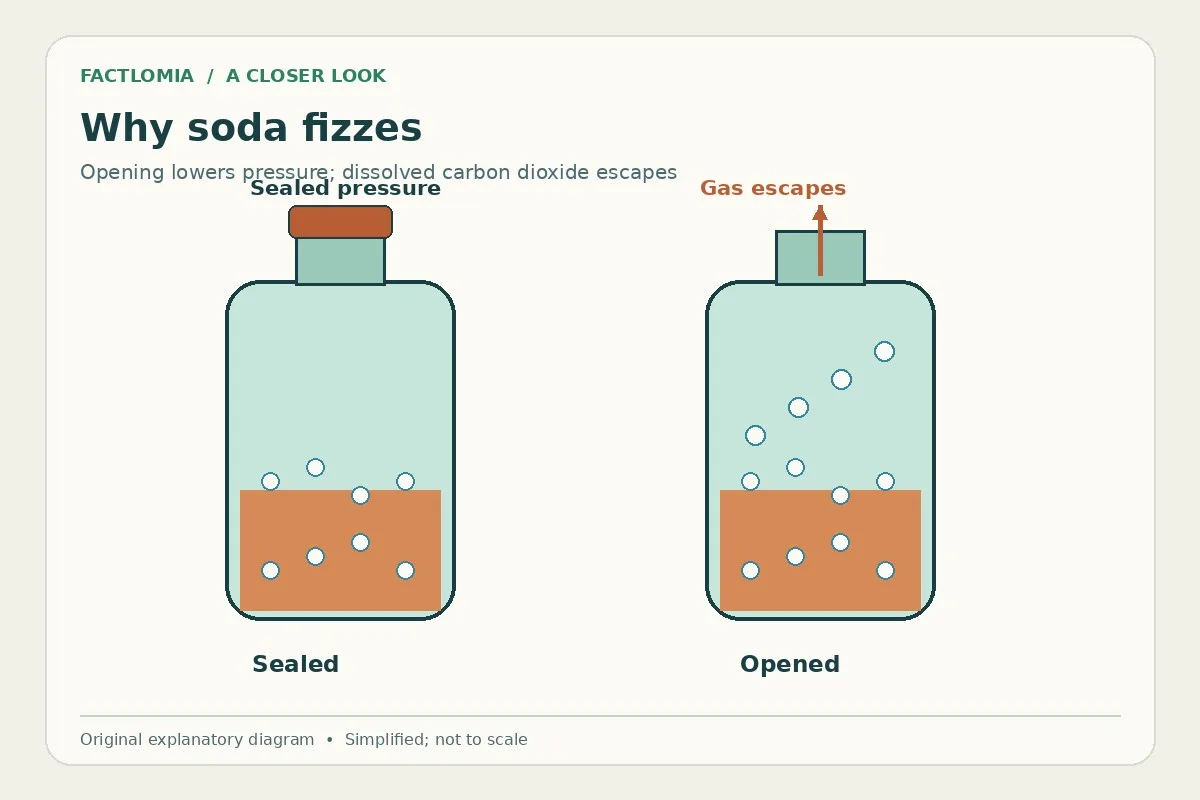
Soda fizzes when opened because it contains dissolved carbon dioxide under pressure. Removing the cap lowers the pressure above the drink, making it easier for carbon dioxide to leave the liquid. Bubbles form at tiny nucleation sites, rise, and carry gas to the surface. Warmth and shaking can speed the release.
Pressure keeps extra carbon dioxide dissolved
During carbonation, carbon dioxide is forced into a cold drink under pressure. More gas dissolves than would remain in the liquid at ordinary atmospheric pressure. When the container is sealed, the pressure above the drink helps maintain that balance. The hiss at opening is gas moving out as the pressure rapidly drops. [1]
This behavior follows Henry’s law: at a given temperature, the amount of a gas dissolved in a liquid generally increases with the gas pressure above it. Once the can or bottle is opened, the liquid is no longer in equilibrium with the surrounding air, so carbon dioxide begins escaping. [2]
Tiny sites help bubbles start
A bubble does not have to appear from nowhere in perfectly smooth liquid. Scratches, fibers, dust, and other small surface features can act as nucleation sites where dissolved gas gathers. As a bubble grows, it detaches and rises. The stream of bubbles is the visible part of carbon dioxide leaving the drink. [2]
Shaking can distribute many small bubbles through the liquid and help gas reach the headspace. When the container is opened, that gas expands and pushes liquid along with it, sometimes producing an overflow. The size of the spill depends on the drink, temperature, container, and how vigorously it was shaken.
Why warm soda loses fizz faster
Carbon dioxide is less soluble in warmer water than in colder water. A warm drink therefore tends to lose its dissolved gas more readily once opened. Keeping a drink cold slows the escape, although it does not prevent it indefinitely. [1]
A glass of soda can go flat even without a dramatic foam-up: carbon dioxide gradually transfers from the liquid into the air above it. The bubbles in a poured drink are not a new ingredient being created; they are gas leaving solution. For a different reaction that visibly releases gas, see why baking soda fizzes with vinegar.
Frequently asked questions
Does soda fizz because the drink is boiling?
No. The bubbles are mainly carbon dioxide escaping from the liquid, not water vapor from boiling.
Why does cold soda stay fizzy longer?
Carbon dioxide is more soluble in colder liquid, so it generally escapes more slowly.
Why can shaking make soda spray?
Shaking encourages gas to form many small bubbles. Opening the container releases pressure, allowing the gas to expand and carry liquid out.
Sources and evidence
- American Chemical Society — The Secret Science of Soda Pop ↗
Explains carbonation under pressure, warming, shaking, and gas release when opened.
- Liger-Belair et al. — Carbonated beverages and bubble formation ↗
Reviews carbon dioxide pressure, temperature dependence, nucleation, and bubble growth in carbonated drinks.
Sources consulted: 2026-10-27. Written with AI assistance and checked against the linked references; not independently reviewed by a subject specialist. Sources do not endorse this article. See our editorial policy.
Revision: First published 27 October 2026. Original explanatory diagram; claims checked against linked sources.