
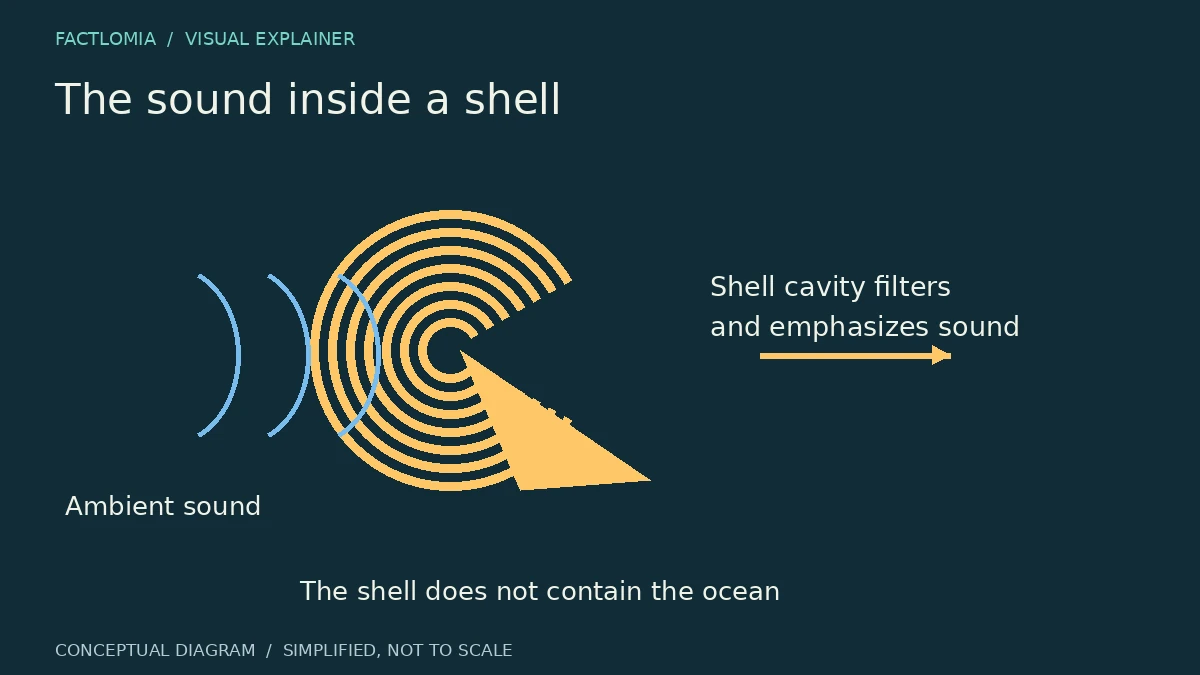
A shell held near your ear changes the background sound reaching you. Its hollow shape favors some frequencies and reduces others, creating a rushing sound that resembles surf. The shell is not storing a recording of the ocean. A similar effect can occur with an empty cup because the important ingredient is an acoustic cavity.
Quiet places still contain background sound
Air movement, distant activity, and household equipment create background noise that you may barely notice. A shell close to the ear changes how parts of that noise are heard. The sound does not require the shell to be beside the sea. [1]
The cavity acts as a sound filter
Sound interacts with the air and hard surfaces inside the cavity. Resonance favors particular frequencies, and the shell’s dimensions influence the result. Different shells can therefore produce different tones from the same surrounding noise. [1]
A cup can create a similar effect
A hollow object need not come from an animal to alter sound near the ear. Comparing a shell with an empty cup helps separate the physics of the cavity from the idea that seawater or an ocean memory remains inside the shell. [1]
Real acoustics are more complex than amplification
Experiments with tubes held near ears have measured both resonance and antiresonance: some frequency regions are emphasized and others reduced. These studies help explain why the effect is better described as filtering sound than turning every sound up equally. [2]
Keep exploring: why a passing siren changes pitch.
Sources and evidence
- Chris Brennan-Jones, Curtin University — Curious Kids: Seashell Sounds ↗
Ambient sound, shell cavities, and a similar effect with an empty cup.
- Elucidation of Sound Perception Effects Using Proximity Resonance Tubes ↗
Measurements of resonance and antiresonance near ears using acoustic tubes.
Sources consulted: 2026-10-28. Written with AI assistance and checked against the linked references; not independently reviewed by a subject specialist. Sources do not endorse this article. See our editorial policy.
Revision: First published 28 October 2026. Sources checked and original explanatory graphic added.