
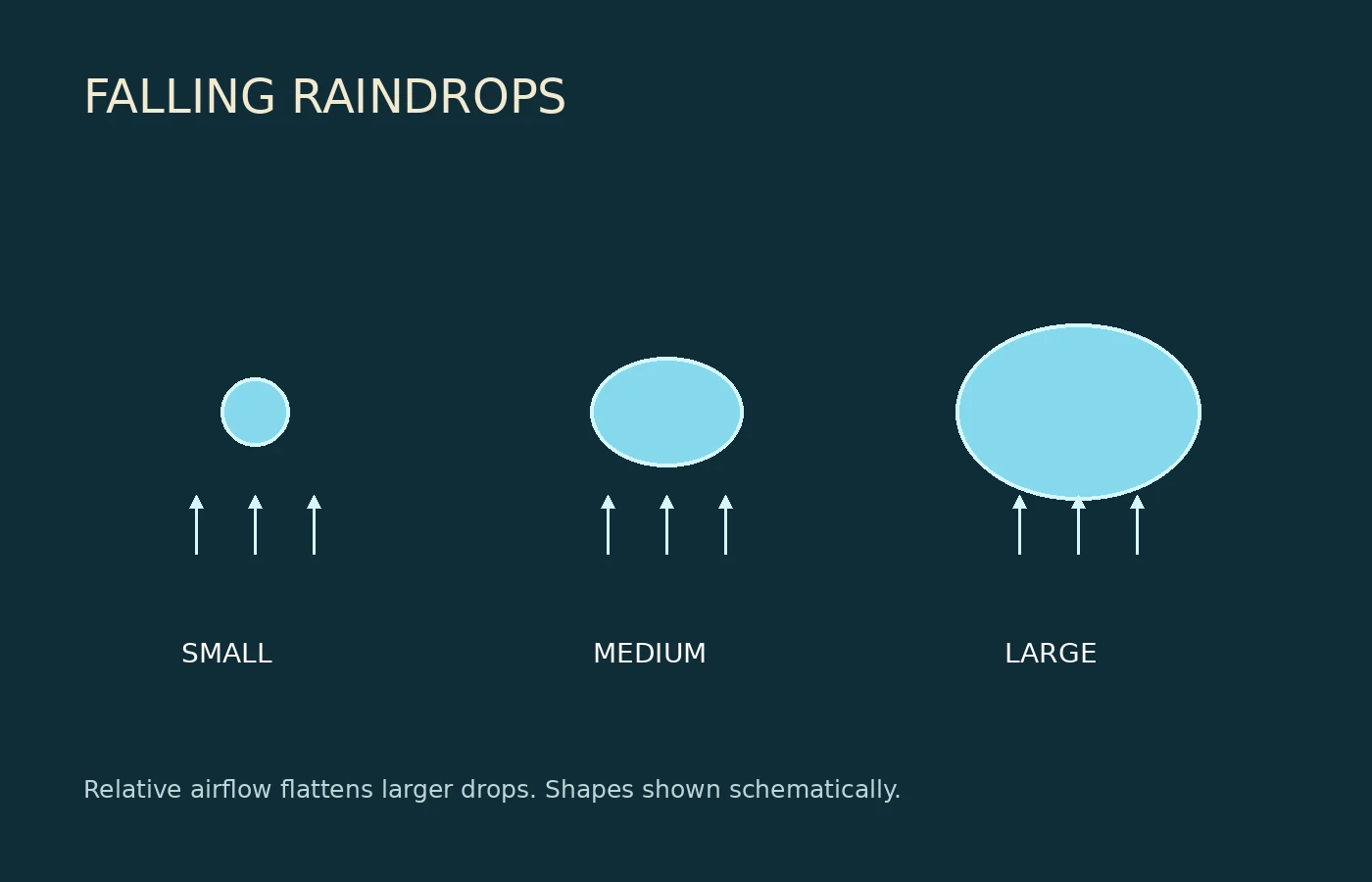
Raindrops have different sizes because droplets in clouds do not all grow at the same rate. Larger cloud droplets fall faster, collide with smaller ones, and collect water. Updrafts, wind, and breakup also shape the range. Falling raindrops are usually flattened rather than teardrop-shaped.
Cloud droplets start tiny
Clouds contain tiny droplets formed on particles such as dust, salt, or smoke. In warm clouds, droplets grow as they collide and merge. In mixed-phase clouds, ice processes can also help precipitation particles grow before they melt into rain. [1]
Collisions make a range of sizes
Droplets encounter different neighbors and air currents. Larger ones generally fall faster and can catch smaller ones. Updrafts may carry droplets upward or slow their descent. The resulting drop-size distribution matters to meteorologists because it affects radar measurements. [2]
Why large drops break apart
Air pushes against a falling drop. Small drops remain close to spherical, but larger ones flatten underneath as aerodynamic forces increase. The largest drops become unstable and break into smaller drops. NASA describes fall speed as increasing with size up to a maximum for the largest drops. See also how fast raindrops fall and how rainbows form.
Frequently asked questions
Frequently asked questions
Are raindrops shaped like teardrops?
No. Small drops are nearly spherical; larger drops flatten underneath as they fall.
Why does heavy rain have larger drops?
Cloud growth and collisions can create a range of drop sizes, but rain rate alone does not determine every drop’s size.
Can weather radar measure drop size?
Specialized radar and instruments can estimate drop-size distributions, but each method has limits.
Sources and evidence
- USGS — Raindrops Are Different Sizes ↗
Explains droplet growth and variation in raindrop sizes.
- NOAA — Atmospheric Collisions ↗
Describes collision, coalescence, and breakup.
- NASA GPM — How Fast Do Raindrops Fall? ↗
Explains drop size and terminal fall speed.
Sources consulted: 2026-10-18. Written with AI assistance and checked against the linked references; not independently reviewed by a subject specialist. Sources do not endorse this article. See our editorial policy.
Revision: Initial editorial draft prepared 18 October 2026; claims are tied to linked sources and retain stated limitations.