
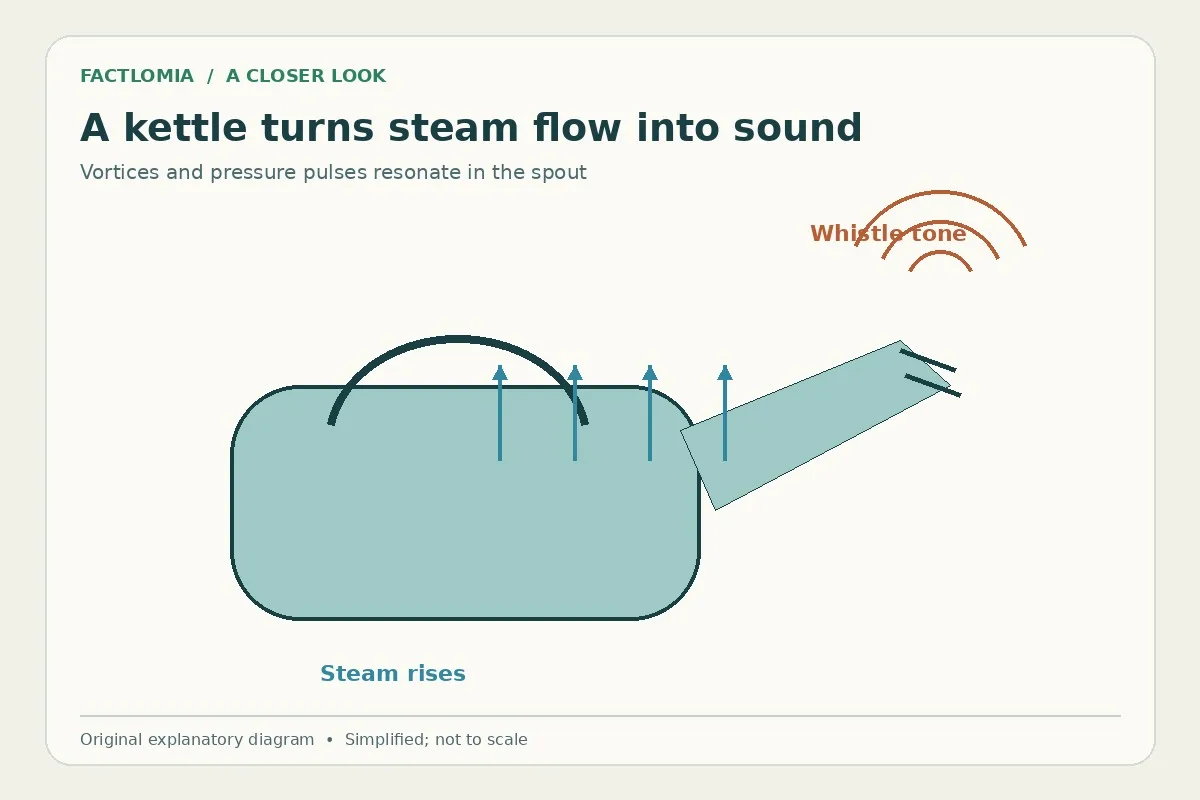
A kettle whistles when steam and fast-moving air pass through its spout and whistle insert, producing repeating pressure pulses. The spout’s geometry helps those pulses resonate as an audible tone. Research on kettle whistles has identified a coupled flow-and-sound process rather than a simple note made only by steam rubbing against an edge.
Boiling sends a flow through the spout
As water boils, it produces steam that moves up through the kettle’s spout. Many kettle spouts include two closely spaced openings or plates. The flow interacting with these edges creates small vortices and pressure fluctuations. When those fluctuations feed back into the airflow in the right way, they can produce a clear whistle. [1]
Researchers at the University of Cambridge studied the mechanism using acoustic and flow measurements. They found two stages: the whistle can begin at lower flow rates through one mechanism, then shift to a stronger tone as the flow increases. The sound depends on the spout geometry and the interaction between the steam jet and the openings. [1][2]
The spout helps select a tone
A kettle spout is not just a pipe that carries steam. Its size and shape influence how the flow oscillates and which frequencies become prominent. The resulting sound is an example of aeroacoustics: sound generated by moving air or gas. Similar flow-and-resonance effects occur in other whistles, although each device has its own geometry. [2]
This is why kettles can sound different from one another. Changes in spout dimensions, whistle inserts, flow rate, or buildup near an opening can change the pitch or loudness. The boiling water is the source of the steam flow, while the whistle assembly helps turn that flow into a tone.
What the whistle tells you
The whistle is a cue that the kettle is producing substantial steam, but its timing varies by kettle and conditions. It is not a precise thermometer: water can be close to boiling before the whistle reaches full volume, and an electric kettle may switch off using a separate temperature or steam sensor. [1]
Keep the spout unobstructed and handle hot steam carefully. The sound itself is a neat reminder that pressure changes can become audible. For another question about how sound moves through a medium, read why sound travels faster in water than in air.
Frequently asked questions
Is the whistle just steam rubbing against metal?
No. The sound comes from interactions between the flow, vortices, openings, and acoustic resonance in the spout.
Why do different kettles have different pitches?
The whistle geometry and flow conditions help determine the frequencies produced.
Does a whistle prove the water is exactly at 100°C?
Not by itself. Boiling temperature changes with pressure and altitude, and the whistle is not a calibrated temperature measurement.
Sources and evidence
- University of Cambridge — How the kettle got its whistle ↗
Summarizes experimental work on vortex formation and the two whistle-production mechanisms.
- American Institute of Physics — Whither the Teakettle Whistle ↗
Reports researchers’ findings on flow, resonance, and the steam-kettle whistle.
- Henrywood & Agarwal — The aeroacoustics of a steam kettle ↗
Primary research on the coupled hydrodynamic and acoustic mechanism of kettle whistles.
Sources consulted: 2026-10-27. Written with AI assistance and checked against the linked references; not independently reviewed by a subject specialist. Sources do not endorse this article. See our editorial policy.
Revision: First published 27 October 2026. Original explanatory diagram; claims checked against linked sources.