
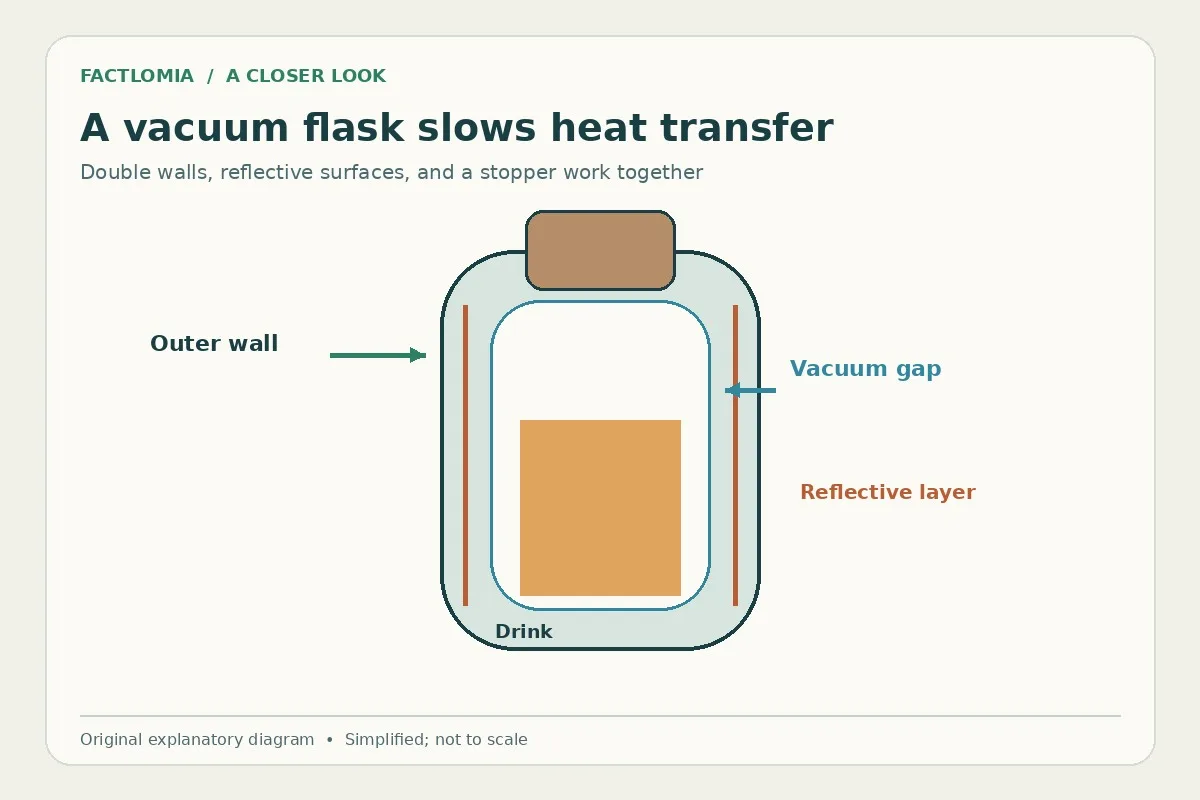
A vacuum flask slows heat from moving between the drink and the environment. Its double walls contain a vacuum that greatly reduces heat transfer by conduction and convection. Reflective surfaces reduce heat transfer by radiation, while an insulating stopper limits heat exchange through the opening.
A vacuum blocks two routes for heat
Heat can move by conduction, convection, and radiation. In a double-walled flask, the gap between the walls is evacuated to create a vacuum. With very few particles in that space, there is little material to carry heat by conduction or convection. The walls still connect at some points, so heat transfer is reduced rather than made impossible. [1][2]
The inner and outer walls can also have reflective surfaces. These reduce heat transfer by radiation, which does not require air or another material to travel. The combination matters: the vacuum reduces particle-based transfer, while the reflective surface helps limit radiant exchange. [1][2]
The stopper and neck still matter
The mouth of the flask is a potential path for heat to escape or enter. A tight stopper reduces the movement of warm air and limits direct contact between the drink and the outside. Some heat can still pass through the neck and stopper, and opening the flask allows warm air to leave and cooler air to enter. [1]
That is why performance depends on the design and how the flask is used. A damaged vacuum seal, a loose lid, or frequent opening can make a drink change temperature more quickly. A flask also slows temperature change in both directions: it can help keep cold drinks cool as well as hot drinks warm.
Why insulation never stops heat flow completely
A thermos is an insulator, not a source of heat. The drink gradually moves toward the temperature of its surroundings because some energy still transfers through the stopper, the neck, and structural connections between the walls. The rate depends on flask construction, starting temperatures, fill level, and how often it is opened. [2]
The same heat-transfer ideas explain why a refrigerator needs insulation and a cooling system. A flask is passive: it slows heat movement without actively pumping energy away. Compare this with how a refrigerator keeps food cold.
Frequently asked questions
Is there literally empty space between the walls?
Manufacturers evacuate most of the air to create a low-pressure space. It reduces conduction and convection; it is not a perfect, absolute vacuum.
Why are the walls shiny?
Reflective surfaces reduce heat transfer by radiation.
Can a flask keep a drink hot forever?
No. It slows heat exchange, but heat still passes through the stopper, neck, and structural connections over time.
Sources and evidence
- University of Queensland Physics Museum — Vacuum Flask ↗
Explains the double wall, vacuum, reflective surfaces, and insulating stopper.
- University of Colorado Boulder — Thermos Demonstration ↗
Demonstrates how vacuum and silvering reduce conduction, convection, and radiation.
Sources consulted: 2026-10-27. Written with AI assistance and checked against the linked references; not independently reviewed by a subject specialist. Sources do not endorse this article. See our editorial policy.
Revision: First published 27 October 2026. Original explanatory diagram; claims checked against linked sources.