
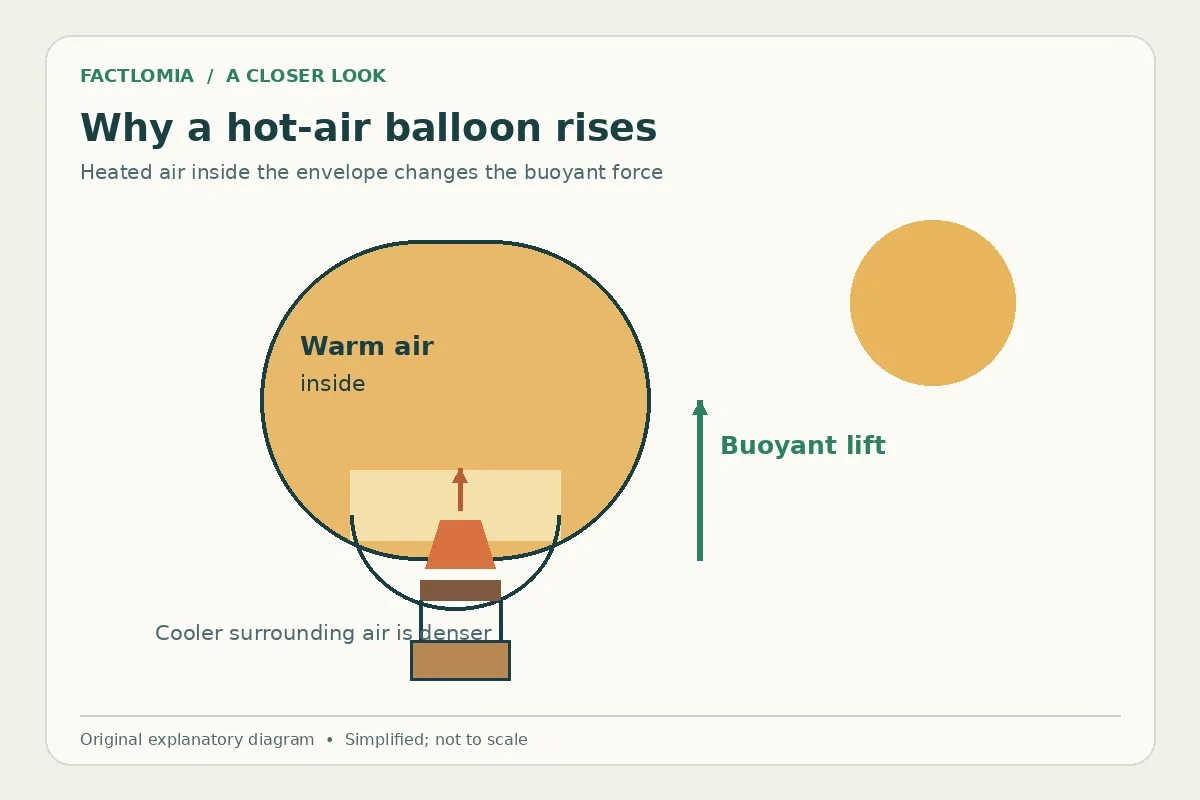
A hot-air balloon rises because the air inside its envelope is heated until the balloon, its air, basket, passengers, and equipment together weigh less than the cooler air displaced outside. The surrounding air exerts an upward buoyant force. A pilot climbs by adding heat and descends as the envelope cools or vents hot air.
The balloon does not push against the air
A balloon is buoyed upward by the surrounding atmosphere, much as a boat is supported by water. The key comparison is the weight of the complete balloon system and the weight of the outside air that occupies the same volume. If the displaced air weighs more, the net force is upward. The envelope, basket, fuel, passengers, and the air inside all count in that comparison. [1]
Heating the air inside the envelope makes it expand. At nearly the same pressure, warmer air has lower density because the same volume contains less mass. The burner does not create a vacuum or make gravity disappear; it changes the density of the air held inside the envelope. [2]
How the burner controls altitude
To climb, the pilot fires the burner and raises the temperature of the air inside the envelope. That increases the density difference between inside and outside air, increasing buoyant lift. The balloon begins to descend when the air cools or when hot air is released through a vent. These changes take time because the envelope and its large volume of air have thermal inertia. [2]
A balloon is not steered forward by its burner. Wind carries it horizontally, and winds can blow in different directions at different heights. A pilot can use those layers to influence the route while controlling altitude. This is why weather information and careful launch planning matter.
Why the basket can rise with a heavy load
The lift comes from a large volume of displaced air, not from the basket being light by itself. A passenger balloon needs enough heated air to lift the envelope, basket, fuel, crew, and passengers while retaining a safety margin. The temperature limit of the envelope and the outside air conditions also affect how much lift is available. [3]
The same buoyancy principle explains why helium balloons rise, although helium is less dense than air without heating. For a separate example of gravity and motion in the atmosphere, see how spiders disperse by ballooning; that biological use of air currents is a different process.
Frequently asked questions
Does a hot-air balloon rise because hot air itself moves upward?
Warm air is less dense, but the balloon rises because the surrounding cooler air exerts a net buoyant force on the complete balloon system.
How does a balloon come down?
The pilot can let the envelope cool or release some hot air through a vent, reducing lift.
Can the pilot steer the balloon?
There is no forward engine in a typical hot-air balloon. The pilot changes altitude to work with wind directions at different heights.
Sources and evidence
- Smithsonian National Air and Space Museum — Buoyancy ↗
Explains how buoyancy supports hot-air balloons and the displaced-air comparison.
- Federal Aviation Administration — Balloon Flying Handbook, Chapter 2 ↗
Describes envelope heating, lift, and altitude control.
- Federal Aviation Administration — Piloted Balloons ↗
Defines balloons as lighter-than-air aircraft sustained by gas buoyancy or an airborne heater.
Sources consulted: 2026-10-27. Written with AI assistance and checked against the linked references; not independently reviewed by a subject specialist. Sources do not endorse this article. See our editorial policy.
Revision: First published 27 October 2026. Original explanatory diagram; claims checked against linked sources.