
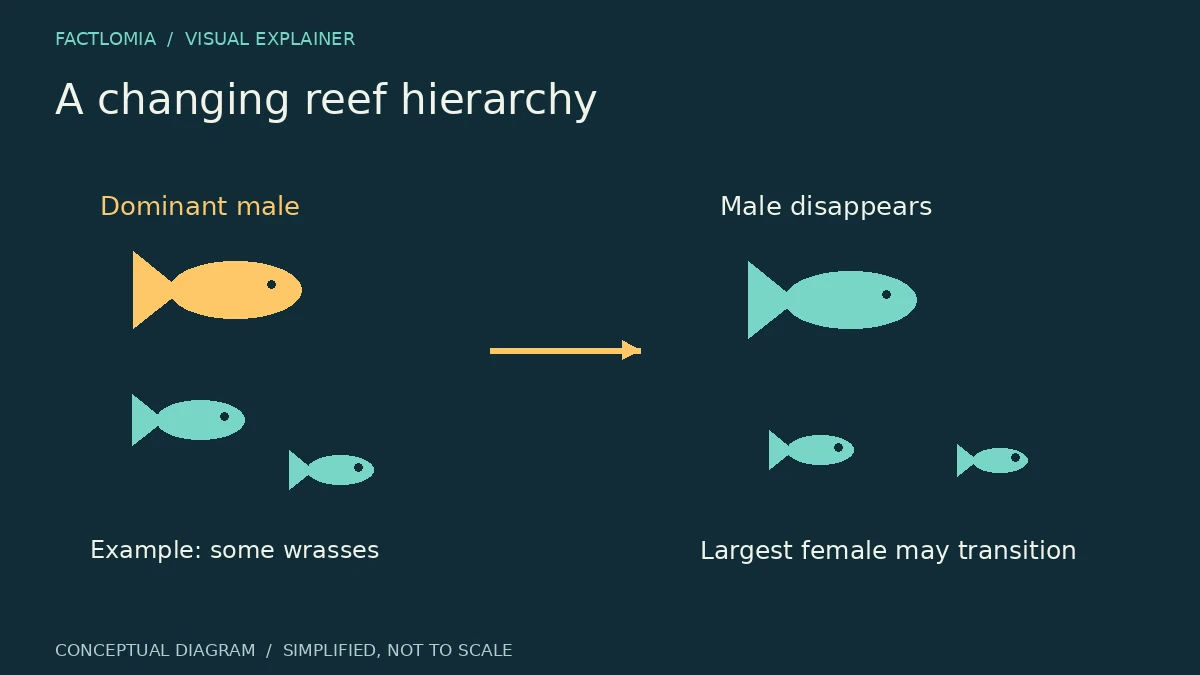
Some fish change sex during their lives because their reproductive strategy responds to age, body size, or social conditions. In the bluehead wrasse, the largest female can begin changing to a male when the dominant male disappears. The transition includes behavioral and hormonal changes and a remodeling of the gonads. This ability occurs in some fish species, not in fish generally.
A changing social group can alter who reproduces
Bluehead wrasses live in social groups where a dominant male defends spawning sites. Field experiments found that when this male was removed, the largest female began displaying male-typical behavior and changed sex. When the removed male was replaced, the comparable control groups did not show the same response. [1]
Behavior can shift before the body finishes changing
The response unfolds in stages. A socially dominant female may begin male-typical behaviors rapidly, while the gonads take longer to transform. In the studied bluehead wrasse, mature sperm production followed over days. The exact pace and details vary by species and conditions; the result is not an instant switch. [1][2]
Social cues connect with internal biology
Research on bluehead wrasses links social change with shifts in gene activity and hormone signaling involved in maintaining ovarian tissue and developing testicular tissue. The social environment is a trigger in this species, but it acts through the fish’s physiology. Other sex-changing fish can use different cues and change in the opposite direction, from male to female. [2][3]
Why would sex change be useful?
In a group where a large individual can reproduce more successfully in one sex, changing sex can allow an animal to take advantage of a new social or size position. It is an evolved reproductive strategy, not a choice in the human sense. See another example of unusual fish reproduction in how male seahorses carry developing young.
Frequently asked questions
Do all fish change sex?
No. Sex change is a life-history strategy in some fish species and is not typical of fish as a whole.
Can a fish change sex because of its social group?
In bluehead wrasses, experiments show that removing a dominant male can trigger the largest female to begin changing.
Is the change immediate?
Behavior can shift rapidly, but gonadal and reproductive changes occur over a longer sequence.
Sources and evidence
- Warner & Swearer — Social Control of Sex Change in the Bluehead Wrasse ↗
Field experiment showing social removal can induce female-to-male sex change.
- Liu et al. — Stress, Novel Sex Genes, and Epigenetic Reprogramming ↗
Molecular and hormonal processes associated with socially cued sex change.
- Munday et al. — A Social Basis for Development of Primary Males ↗
Research on environmental and social influences in bluehead wrasse sex development.
Sources consulted: 2026-10-27. Written with AI assistance and checked against the linked references; not independently reviewed by a subject specialist. Sources do not endorse this article. See our editorial policy.
Revision: First published 27 October 2026. Original explanatory diagram; claims checked against linked sources.