
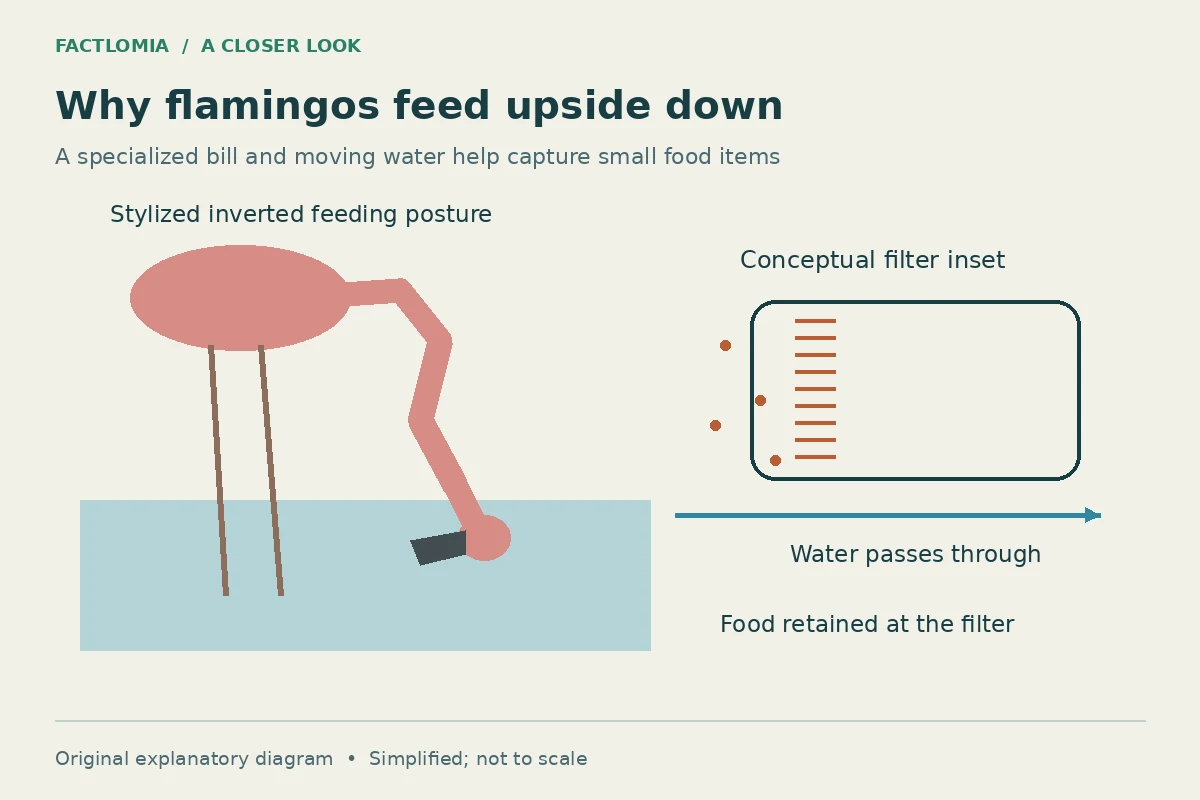
Flamingos eat with their heads upside down because their curved bills and feeding movements work in that orientation. Comb-like structures help retain food while water passes through the bill, and the tongue helps move water. Their head and foot movements can also concentrate prey rather than merely waiting for it to drift in.
An inverted head suits a specialized bill
A flamingo lowers its long neck and turns its head so the bill is inverted in the water. The anatomical lower bill is large and deep, while the upper portion can move. This arrangement differs from the familiar pecking action of many birds. The posture is part of a feeding system, not a way to make swallowed water run toward the stomach. [1]
A filter and a moving tongue
Rows of lamellae along the bill act as a sieve. Food capture depends on the species and the spacing of its filtering structures, so flamingos do not all eat the same-sized items. The large tongue and jaw movements help drive water through this system. Water and food are processed together; the bird is not simply drinking a mouthful and swallowing all the mud. [1]
More active than a passive strainer
A 2025 study combined observations of Chilean flamingos, physical models, and fluid simulations. It showed how beak movements, head retraction, and foot movements can create flows that lift and concentrate particles and live prey. The results add a fluid-mechanics explanation to the older filter-feeding description. They do not mean every species uses each movement identically in every habitat. [2]
Does feeding explain their pink color?
The food-capture mechanism and the source of pink plumage are related through diet but answer different questions. The inverted bill helps obtain food; pigments from food contribute to coloration. Keep those mechanisms separate when watching a feeding flock. Read why flamingos are pink for the pigment explanation, or why they stand on one leg for another familiar posture.
Sources and evidence
- Stanford — Flamingo Feeding ↗
Bill anatomy, inverted feeding, lamellae, and tongue-driven water movement.
- Ortega-Jimenez et al. — Flamingo vortical traps ↗
Primary 2025 experiments on active prey-concentrating flows.
Sources consulted: 2026-10-21. Written with AI assistance and checked against the linked references; not independently reviewed by a subject specialist. Sources do not endorse this article. See our editorial policy.
Revision: First published 21 October 2026. Source-linked explanation and original diagram.