
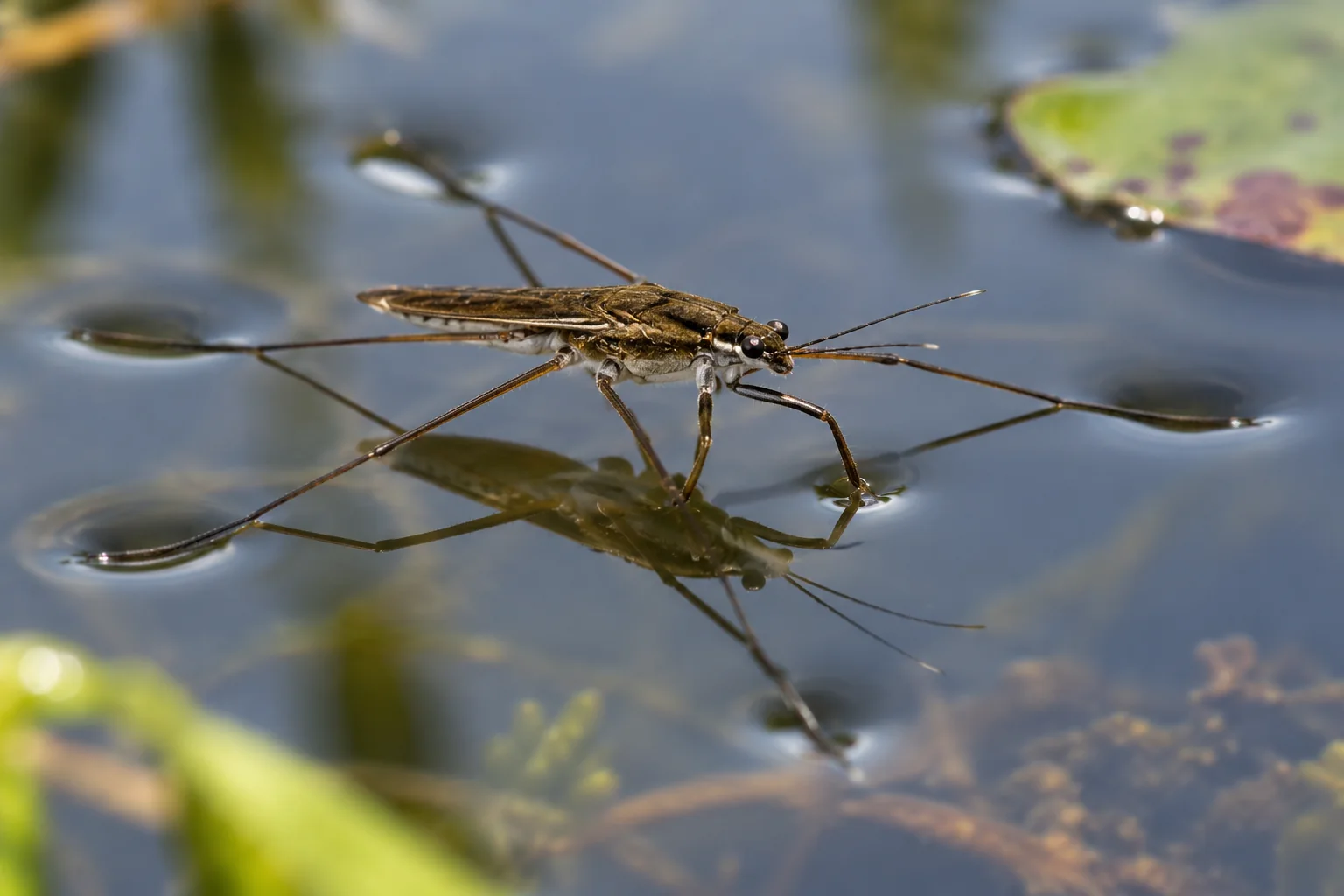
Water striders walk on water because their light bodies and water-repellent, finely textured legs distribute weight across the surface. Water’s surface tension resists being pierced, while tiny hairs on the insects’ legs trap air and help keep them dry. Their weight is small enough that the surface bends but does not break.
Water’s surface behaves like a stretched film
Water molecules attract one another, creating surface tension at the boundary between water and air. A water strider is light, and its legs spread the load across several points. Instead of piercing the surface, the legs make shallow dimples. USGS explains that small insects can move across water because of surface tension. [1]
Legs repel water and spread force
Dense microscopic hairs repel water and trap air. This reduces wetting and helps the insect distribute force. Middle legs provide much of its forward push, while other legs steer and stabilize it. The insect is not standing on a solid layer; it uses surface physics and specialized anatomy. [2]
What changes if the surface tension falls?
Soap and other surfactants reduce surface tension. If the surface is disturbed enough or the insect becomes wet, it may lose support. This is why a tiny insect can move over a quiet pond but not any liquid. Compare its grip with spiders walking on ceilings and the sensing ability of bees near flowers.
Frequently asked questions
Frequently asked questions
Do water striders use their legs like oars?
Yes. They push against the surface with their middle legs and use other legs to steer.
Can water striders walk on soapy water?
Soap reduces surface tension and can disrupt the support they rely on.
Are they the only animals that walk on water?
No. Some small insects and spiders also use low body mass, water-repellent surfaces, and surface tension.
Sources and evidence
- USGS — Surface Tension and Water ↗
Explains surface tension and how water striders use it.
- USGS — Surface Tension Allows a Water Strider to Walk on Water ↗
Illustrates the surface-tension effect.
- National Park Service — Water Striders ↗
Describes movement and the effect of surfactants.
Sources consulted: 2026-10-18. Written with AI assistance and checked against the linked references; not independently reviewed by a subject specialist. Sources do not endorse this article. See our editorial policy.
Revision: Initial editorial draft prepared 18 October 2026; claims are tied to linked sources and retain stated limitations.