
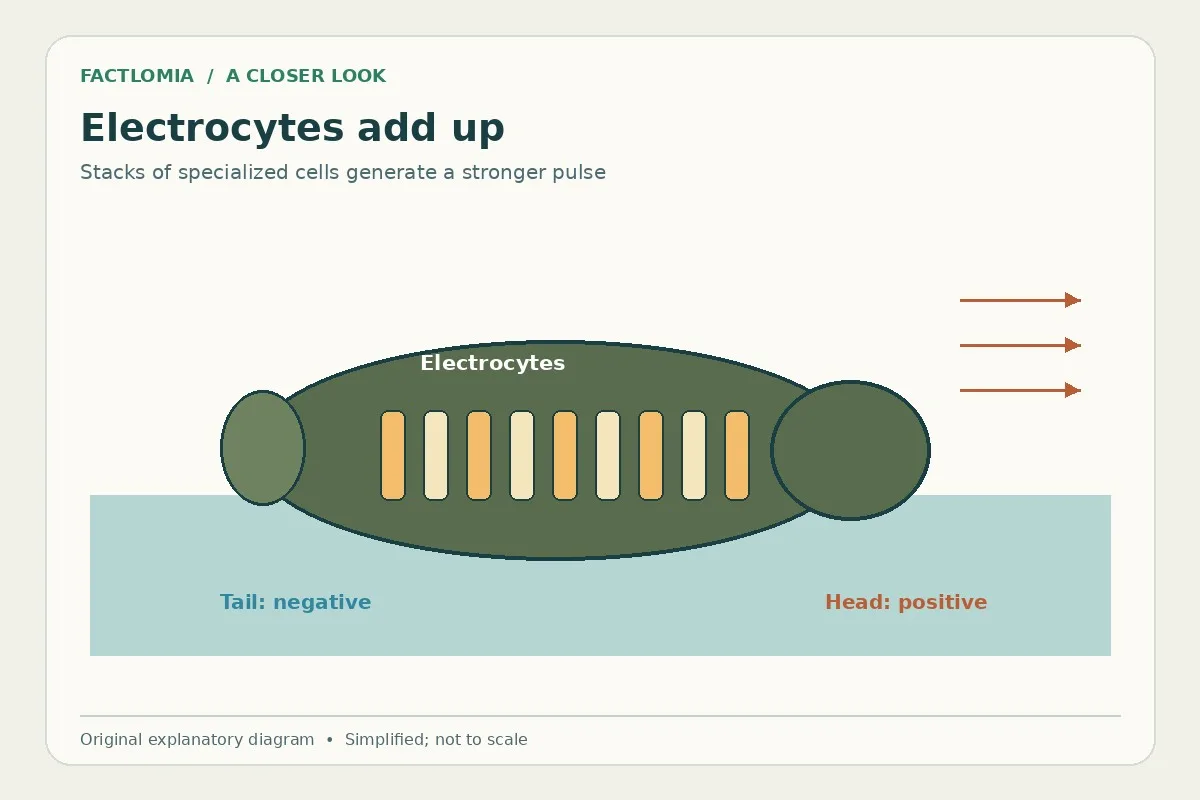
Electric eels generate electricity with specialized organs containing thousands of modified muscle cells called electrocytes. Each cell produces a small voltage; when many cells discharge in a coordinated sequence, their voltages add up. Eels use weaker electrical signals for sensing and communication and stronger discharges to stun prey or defend themselves.
Modified muscle cells act like tiny batteries
An electric eel’s electric organs contain electrocytes, cells derived from muscle tissue that can produce electrical differences across their membranes. A single cell produces only a small voltage. But the cells are arranged in stacks, so their electrical contributions can add together, much like batteries connected in series. [1][2]
The fish has three electric organs: the main organ, Hunter’s organ, and Sachs’ organ. They generate discharges with different strengths and roles. The organs make up much of the eel’s elongated body, while vital organs are concentrated toward the front. [1]
Weak signals and strong shocks do different jobs
Electric eels can use low-voltage pulses to sense their surroundings and communicate in murky water. These signals help them detect objects and other electric fish. When hunting or defending themselves, they can produce much stronger bursts. The Smithsonian describes electric discharges as tools for defense, hunting, communication, and navigation. [1][3]
In a dark, cluttered habitat, the eel can also combine electrical signals with its lateral-line system, which detects movement in nearby water. A Smithsonian account describes a rapid electrical doublet that can trigger prey muscles to twitch, helping the eel locate them before delivering stronger pulses. [3]
How powerful is the discharge?
The largest electric eel species can produce discharges of hundreds of volts; the reported maximum depends on species, size, and measurement. Smithsonian sources describe values up to about 800 volts for electric eels. That does not mean every discharge reaches that level, or that voltage alone predicts the effect: current, duration, distance, and the path through the body also matter. [1][2]
Despite its name and shape, an electric eel is not a true eel. It belongs to a group of knifefishes. It must also surface periodically to breathe air, an adaptation that helps it live in warm, poorly oxygenated waters. [1] Compare its electricity-producing organs with the sensing system described in how sharks detect electrical signals.
Frequently asked questions
Are electric eels really eels?
No. They are knifefishes, more closely related to catfish and carp than to true eels.
How do their cells make a large shock?
Many electrocytes discharge together, and their small voltages add up across the organ.
Do electric eels use electricity only to attack?
No. They also use weaker signals for sensing and communication.
Sources and evidence
- Smithsonian National Zoo — Electric Eel ↗
Describes three electric organs, their functions, and electrical discharges.
- Smithsonian National Zoo — It’s Electric (Fishes)! ↗
Explains stacked electrocytes and electrical signaling.
- Natural History Museum — How do electric eels work? ↗
Explains electrocytes, electric organs, and different signal strengths.
Sources consulted: 2026-10-27. Written with AI assistance and checked against the linked references; not independently reviewed by a subject specialist. Sources do not endorse this article. See our editorial policy.
Revision: First published 27 October 2026. Original explanatory diagram; claims checked against linked sources.