
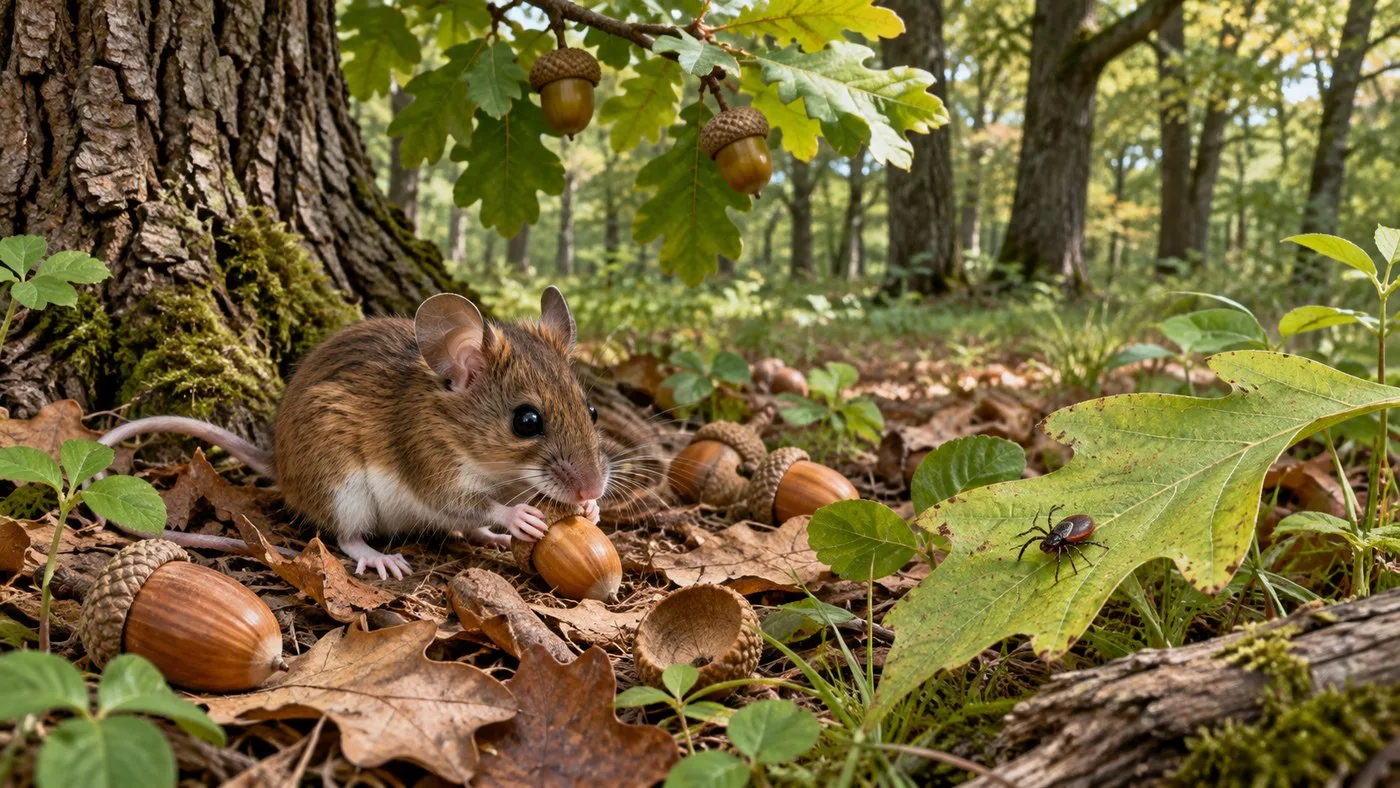
In one long-term study in Lyme-endemic New York, more red-oak acorns were linked to more white-footed mice the next year, and mouse abundance was associated with later nymphal tick numbers. Acorn crops may help researchers anticipate tick numbers in that region. The finding is not a precise forecast for every location or an individual’s risk of infection.
A forest food crop can affect the next link
Acorns are an important autumn food for white-footed mice. A large crop can help mouse populations grow the following year. Mice also host black-legged ticks, whose nymph stage is an important source of Lyme disease exposure for people. A 2026 synthesis of more than three decades of monitoring in New York found that acorn production was associated with later mouse and nymphal tick abundance. [1]
Why deer do not explain the whole pattern
Deer feed adult ticks and can help them reproduce, but deer abundance did not reliably predict nymphal tick numbers at the long-term research sites. Mouse abundance was more strongly associated. The number of ticks and the percentage carrying the Lyme bacterium are separate questions; infection prevalence depends on the wider community of animals that larval ticks feed on. [1]
A regional ecological clue, not a personal risk calculator
The study comes from one Lyme-endemic region. Other landscapes have different hosts, predators, tree species and weather. For people, established precautions remain useful where ticks are active: use appropriate repellent, check for ticks after time outdoors and follow local public-health guidance. [2]
FAQ: acorns and Lyme disease
Do acorns cause Lyme disease? No. The disease is caused by bacteria transmitted through infected ticks; acorns can influence mouse populations.
Will a large crop mean more Lyme cases next year? Not necessarily. The study examined ecological patterns, not guaranteed case counts.
Does this apply everywhere? No. It is based on monitoring in New York and needs local evidence elsewhere.
Sources and evidence
- PNAS — The ecology of Lyme disease: Long-term data, surprises, and a synthesis ↗
Primary 2026 synthesis of long-term data on acorns, mice, ticks and Lyme ecology.
- CDC — Preventing Tick Bites ↗
Public-health guidance for reducing tick exposure.
Sources consulted: 14 November 2026. Written with AI assistance and checked against the linked references; not independently reviewed by a subject specialist. Sources do not endorse this article. See our editorial policy.
Revision: Initial publication. Claims and limitations checked against linked institutional and primary sources.