
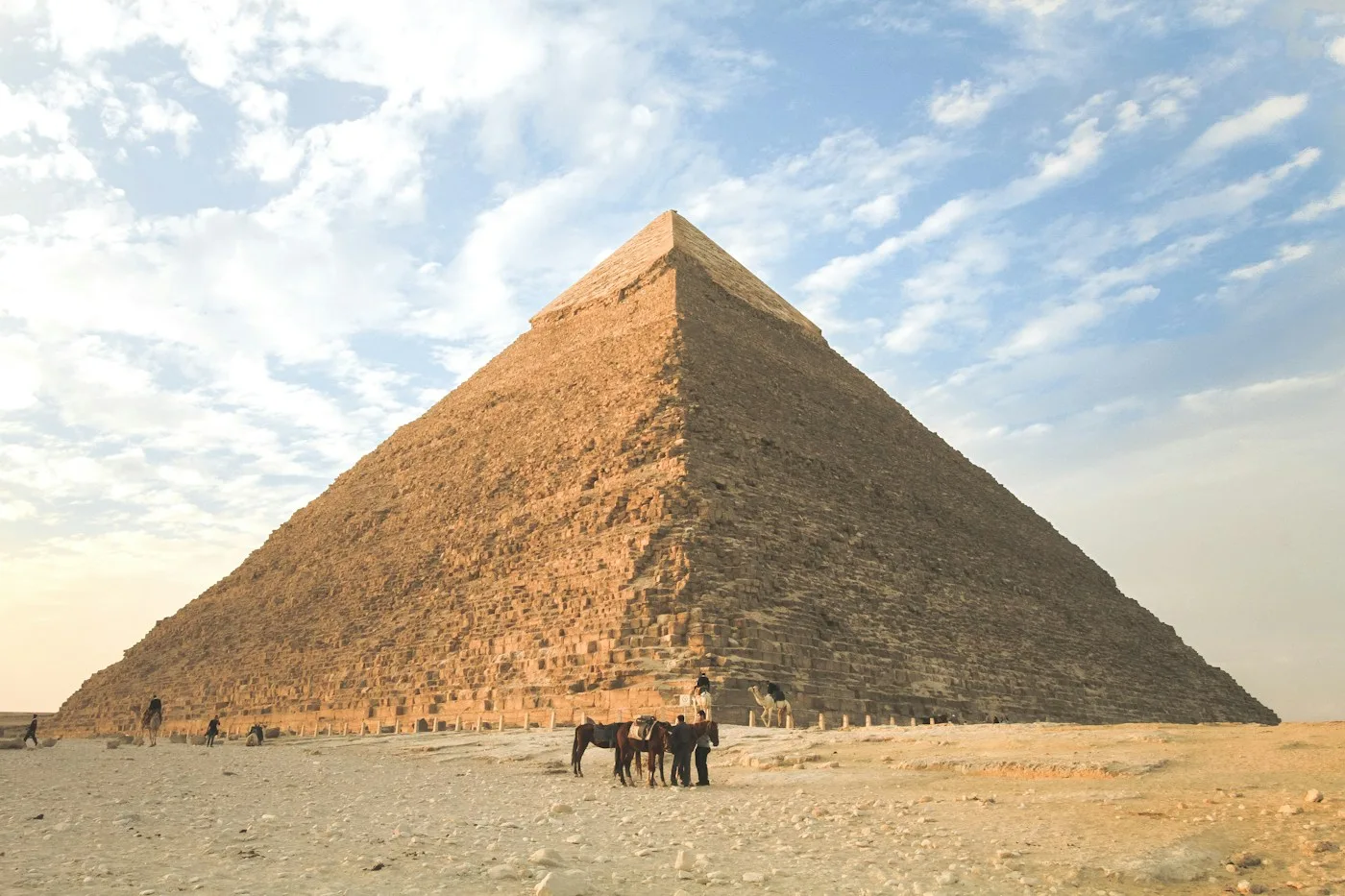
The Great Pyramid of Khufu originally had a smooth outer casing of fine white limestone. Much of it was later removed. Giza’s pyramids did not all have identical finishes: Khafre retains limestone near its summit, while Menkaure used granite for part of its casing.
The Great Pyramid had a finished outer surface
The rough blocks visible across much of Khufu’s pyramid today are not a complete picture of its original exterior. A surviving casing stone held by National Museums Scotland formed part of a fine white limestone layer. The museum describes polished surfaces and identifies Tura as the source of the casing limestone. [1]
The useful distinction is between the structural body of the monument and its outer finish. Removing that finish changes both the apparent texture and the way the sides catch light.
Three pyramids, different surviving clues
| Pyramid | Evidence for its casing |
|---|---|
| Khufu | Surviving fine white limestone casing stones, including a museum example. |
| Khafre | Polished limestone remains near the top. |
| Menkaure | Granite casing on the lower quarter, limestone above. |
The Egyptian Ministry of Tourism and Antiquities describes the preserved limestone on Khafre and the mixed casing of Menkaure. It also notes that many of Menkaure’s granite blocks were left unsmoothed. [2] [3]
That makes “all the pyramids were completely smooth and white” too broad a caption for the entire group.
Where did the Great Pyramid’s casing go?
National Museums Scotland reports that most of Khufu’s casing had been removed by the nineteenth century and that stones were reused for other construction. Some casing remains at the base. [1] This supports a history of removal and reuse; it does not establish one single event that explains every missing block.
How to judge a reconstruction image
Start by identifying which pyramid is shown. Then ask which details are supported by surviving stones or a documented collection. A bright white reconstruction may communicate the limestone finish effectively, but its precise sheen, lighting and intact outline still involve visual choices.
A reconstruction is an interpretation of evidence, not a photograph of antiquity. The image accompanying this article shows a modern view and is not offered as proof of the complete original appearance. Our editorial policy explains this distinction between an illustration and a source.
Sources and evidence
- National Museums Scotland — Casing stone from the Great Pyramid of Giza ↗
Khufu’s white limestone finish, provenance and later reuse of casing.
- Egyptian Ministry of Tourism and Antiquities — Pyramid Complex of Khafre ↗
Surviving polished limestone at the summit.
- Egyptian Ministry of Tourism and Antiquities — Pyramid Complex of Menkaure ↗
Granite and limestone casing, including unfinished granite surfaces.
Sources consulted: 9 October 2026. Written with AI assistance and checked against the linked references; not independently reviewed by a subject specialist. Sources do not endorse this article. See our editorial policy.
Revision: Added monument-specific evidence and corrected the idea of one identical finish across Giza.