
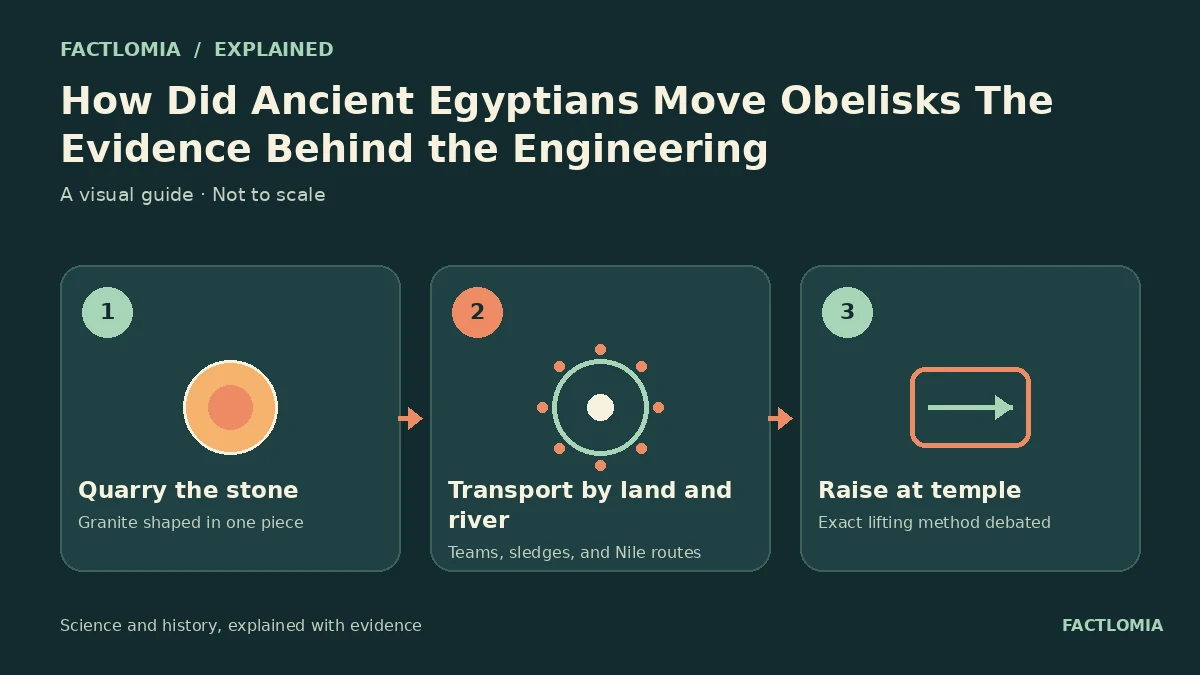
Ancient Egyptians quarried obelisks from granite, moved them over land and water, and raised them at temple sites using large teams and engineering methods that scholars continue to study. The Nile likely helped transport many finished stones on barges. Evidence supports parts of the process, but no single surviving manual documents every lifting step.
A monument begins in the quarry
Many famous obelisks were cut from granite near Aswan. Ancient workers used stone tools and controlled pounding to shape the hard rock; unfinished obelisks left in the quarry reveal how the stone was separated and where cracks could end a project. Quarrying a single tall monolith required planning because the whole monument had to remain intact. [1]
Land routes and the Nile did the heavy work
A carved obelisk had to travel from quarry to temple. Inscriptions and temple reliefs show that Egyptians moved monumental objects with large workforces and river transport. The Nile offered a practical route for heavy cargo, likely using specially prepared barges. On land, sledges and prepared paths are plausible and supported by wider evidence for moving heavy stone, though the precise setup varied and is not fully documented for every obelisk. [2]
Raising the stone is still debated
Archaeologists and engineers have proposed ramps, sand-filled pits, cradles, and other staged lifting methods. Experiments show that some reconstructions can work, but a successful modern demonstration does not prove that ancient builders used that exact design. The safest account separates what is well supported—quarrying, organized labor, river transport—from the details of a particular raising mechanism, which remain a matter of research. [3]
Frequently asked questions
Were obelisks moved by aliens or lost technology?
No. Archaeological evidence points to human labor, stoneworking, transport, and engineering; no extraordinary explanation is needed.
Did the Nile carry obelisks?
River transport is strongly supported by Egyptian imagery and historical context, though the exact barge designs and routes varied.
Do archaeologists know exactly how every obelisk was raised?
No. Several methods have been proposed, and surviving evidence does not establish one universal procedure.
Sources and evidence
- Getty — Obelisks on the Move ↗
Discusses archaeological clues and unresolved questions about transport and erection.
- PBS NOVA — Mysteries of the Nile: Gifts of the River ↗
Explores evidence and experimental models for Nile transport.
- Oxford Academic — Created from Stone: How Egyptian Obelisks Were Made ↗
Scholarly overview of quarrying and transport of ancient Egyptian obelisks.
Sources consulted: 4 November 2026. Written with AI assistance and checked against the linked references; not independently reviewed by a subject specialist. Sources do not endorse this article. See our editorial policy.
Revision: New explainer; distinguishes evidence for transport from debated reconstructions of erection.